WORLD RELIEF CORP.
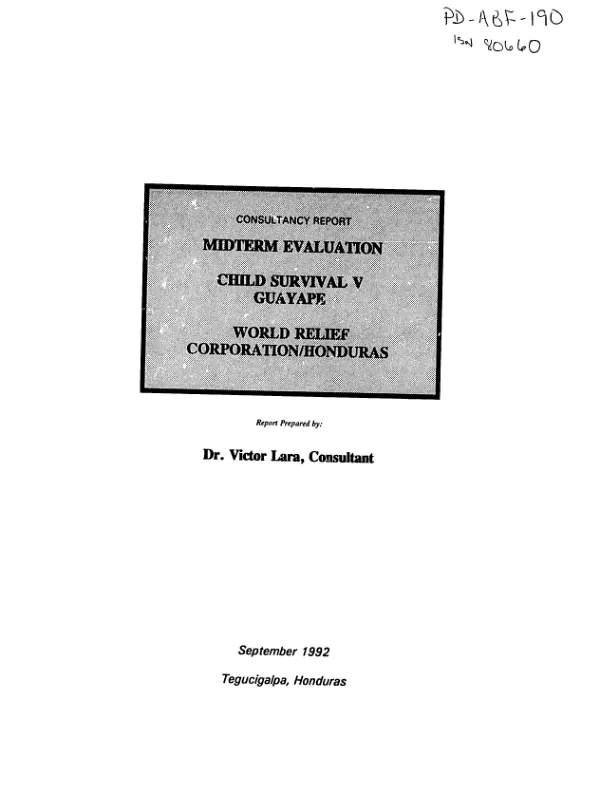
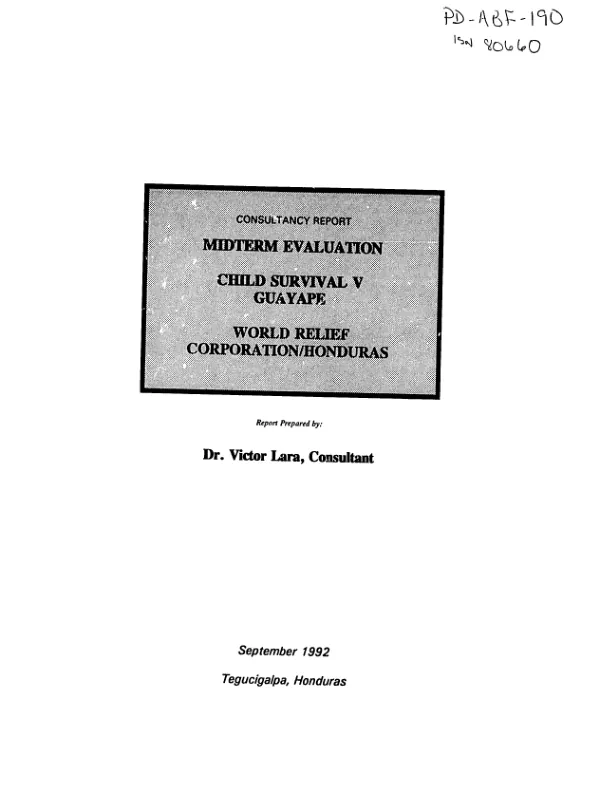
Midterm evaluation : child survival V, Guayape
Interim evaluation of a grant to World Relief Corporation for a child survival (CS) project in the Francisco Morazan and Olancho Departments in Honduras.
Lara, Victor · 1992
Sign in to readA free account is required to download.
Abstract
The evaluation covers the period 9/89- 7/92. The project is achieving its objectives, meeting the needs of the target population, and is considered effective by the mothers who are its direct beneficiaries. Specifically, 7 of 20 project objectives have achieved or exceeded the estimates proposed for the end of the third year -- full immunization of children under age 1, administration of two doses of tetanus toxoid vaccination to women, use of oral rehydration (ORT) by mothers to treat diarrhea, monthly weighing of children aged 0-23 months, exclusive breastfeeding up to 4-6 months, training of mothers in child nutrition, and prenatal care. By contrast, the project has achieved only about 50% of targets for ensuring that mothers refer children with pneumonia and for training mothers to prepare oral rehydration solution (ORS). Nonetheless, nearly 6,000 women are practicing ORT thanks to the efforts not only of the project, but also of the media and other concerned institutions. Initial project objectives have been expanded to include women's care, women's organizations, and promotion of women's income generation through the establishment of community women's banks. Community education has been the project's strongest point. Excellent skills in informal and participative methods of education can be found among project staff. However, there is a shortage, both quantitative and qualitative, of teaching materials. There is also need for more TA in information and training and greater use of existing information. The project must strengthen its sustainability strategies in light of the Ministry of Health's (MOH) financial inability to assume responsibility for the project after the 1994 PACD. Achievements attained so far could be maintained to a certain extent if community structures are solidified and develop linkages with the MOH and other institutions. Sustainability will require implementing each aspect of the program jointly with the MOH. Lessons learned include the following. (1) A successful CS program requires a strategy for meeting nutritional needs. An adequate management and surveillance system is also vital. (2) Local health committees working hand in hand with health volunteers are key to ensuring community participation, although the volunteers should depend on the committees rather than vice versa. There is also a need to diversify the type of volunteer employed. (3) Volunteers cannot be expected to be efficient if they have to visit over 20 families. (4) Weighing sessions of numerous children are ineffective, mainly because mothers have no time to be taught about their children's growth process and because they wear out the health volunteer. The sessions should involve 5-8 children. (5) Health volunteers should not only teach mothers how to prepare ORS, but should prepare and administer the first dosage with mothers and make a follow-up house call to ensure continued usage. (6) Projects that promote birth spacing should also have contraceptive supplies available. (7) Health volunteers who have been trained to apply medical treatment often do not carry out preventive practices, despite their training. (8) Primary schools are a good means of promoting community health education.
Related documents
Documents in this collection
 1992
1992USAID DEC
Midterm evaluation : child survival V, Guayape
Open record 1996
1996USAID DEC
![Midterm evaluation for the period of November 1994 - August 1996 -- final report : child survival activities in Haiti -- integration of sustainable child survival interventions into the mission of CRUDEM [Center for Rural Development of Milot], a private sector organization in the Department of the North, Haiti](https://covers.devme.ai/gen/6090.webp)
![Midterm evaluation for the period of November 1994 - August 1996 -- final report : child survival activities in Haiti -- integration of sustainable child survival interventions into the mission of CRUDEM [Center for Rural Development of Milot], a private sector organization in the Department of the North, Haiti](https://covers.devme.ai/gen/65690.webp)