USAID DEC
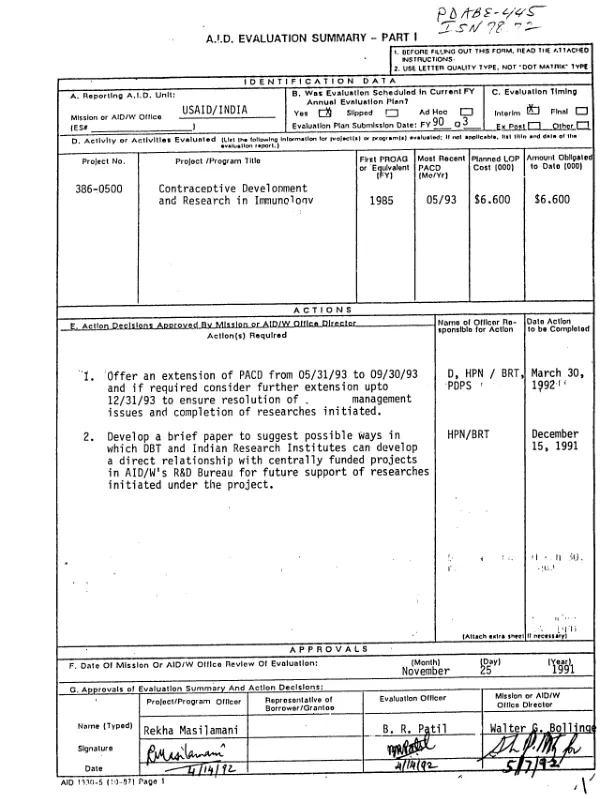
Midterm evaluation of contraceptive development and research in immunology project (CD & RI) (USAID/India project 386-0500)
Sign inDUAL & ASSOCIATES, INC.
Midterm evaluation of contraceptive development and research in immunology project (CD & RI) (USAID/India project 386-0500)
Mid-term evaluation of a project to support collaborative research between Indian and U.S.
Tomaro, John B.|Dorflinger, Laneta · 1992
Sign in to readA free account is required to download.
Abstract
scientists in contraceptive development and disease-related immunology at 4-6 institutions and to finance scholarships for Indian scientists. The evaluation covers the period 1988-7/91. The project has experienced major implementation problems which have significantly delayed proposed activities. Three years after the project launch, collaborative research is just beginning. Delays have occurred in: defining the management structure for day-to-day activities; reviewing collaborative research proposals; and executing the participating agency services agreement with the U.S. Office of International Health/National Institute of Allergies and Infectious Diseases. The project still faces problems in defining intellectual property rights, procuring U.S. scientific equipment, and transferring funds to the Government of India. The project secretariat is partly at fault. It did not systematically implement the instruction of the joint working group or give the project continuous, focused attention at critical points. The secretariat took a less than active role in promoting the project among the participating Indian institutions and failed to expeditiously address managerial and procedural issues. Despite these problems, the collaborative research projects submitted for funding are conceptually very good and scientifically significant, the researchers involved are qualified and motivated, and the four participating Indian research institutes have good infrastructure and research capabilities. Six of eleven collaborative research proposals have been approved and funded; seven new collaborative research relationships have been established; eight research fellowships have been awarded; and several scientific publications have been prepared. Five major lessons were learned. (1) A program that has dual scientific foci complicates the management structure, divides scarce resources, and reduces the prospects of achieving significant results. (2) Project designs should be consistent with the timeframe of the project and the funds available. (3) When multiple agencies are involved, the roles and responsibilities of each must be clearly defined and systems for communicating and coordinating fully elaborated. (4) Collaborative research projects require that procedures and timelines for peer review, approval, and funding be defined at the start of the project and strictly followed. (5) If intellectual property rights issues cannot be resolved, the Mission must refocus projects, perhaps on training scientists or strengthening research institutions.