USAID DEC
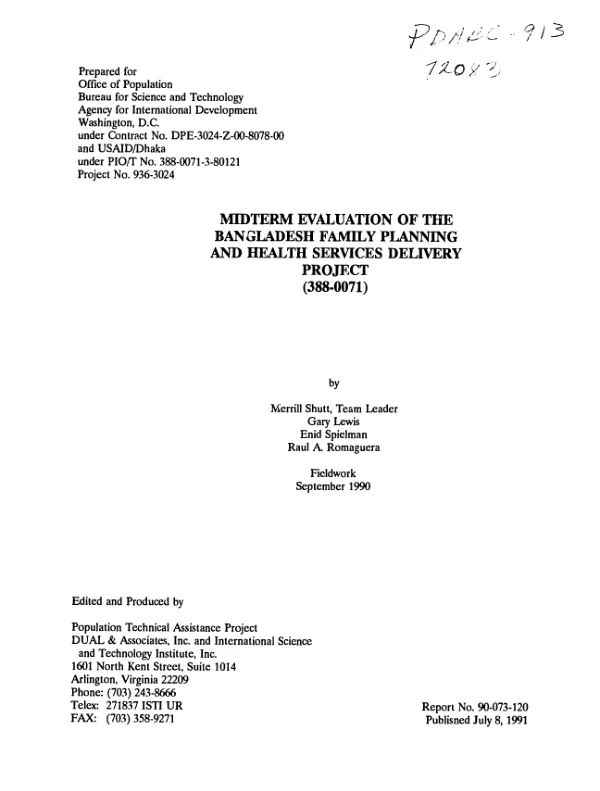
Midterm evaluation of the Bangladesh family planning and health services delivery project (388-0071)
Sign inDUAL & ASSOCIATES, INC.
Midterm evaluation of the Bangladesh family planning and health services delivery project (388-0071)
Evaluates project to improve family planning and maternal/child health (FP/MCH) services in Bangladesh.
Shutt, Merrill|Lewis, Gary · 1991
Sign in to readA free account is required to download.
Abstract
Interim evaluation covers the period 1986-1989. Measurable progress has been made toward achieving FP/MCH goals. The total fertility rate (TFR) fell from 5.6 to 5, the infant mortality rate (IMR) from 128 to 120, and the child mortality rate from 24 to 19. If the TFR continues its downward trend and this is validated in the 1991 contraceptive prevalence survey, the target of 4.8 will likely be reached in 1991. Similarly, if the IMR is sustained, the target of 125 has already been reached. Several of the project's strategies are working as planned. The project has helped increase the contraceptive prevalence rate from 21.7% in 1983 to 32.8% in 1989, and has made a full range of contraceptives available, with oral contraceptives and female voluntary sterilization becoming increasingly popular. Progress is also being made toward decentralization of services. Support to NGO's and to the Social Marketing Company have been major factors in increasing contraceptive prevalence; in fact, NGO contributions to national CYP (couple-years of protection) increased from 11% to 24% between 1981 and 1988. The project has also provided valuable assistance in the areas of research; information, education, and communication materials; and urban immunization. Its achievements in improving the quality of FP/MCH care cannot be assessed, however, as activities for improvement have been minimally implemented. Institution building and sustainability are major concerns. The GOB has repeatedly demonstrated a poor capability to implement and administer development projects and an unwillingness to cooperate with donor organizations; this project, like other donor efforts, is studded with examples of bureaucratic impediments. Another consideration is that commodity support -- long an essential component of A.I.D.'s FP assistance -- is being gradually replaced by support from the World Bank, reducing A.I.D.'s advisory leverage. It is suggested therefore that GOB institution building be given lower priority. Additionally, economic realities make it unlikely that FP programs, including those of NGO's, can reach self-sustainability in the near future. Nonetheless, the importance of building FP services in Bangladesh indicates that self-sustainability should not be the overriding concern.