USAID DEC
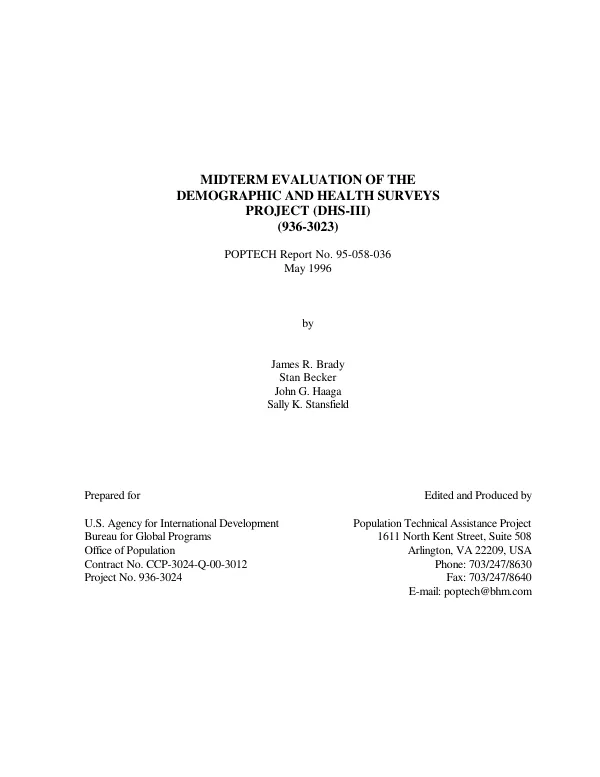
Midterm evaluation of the demographic and health surveys project (DHS-III) (936-3023)
Sign inBASIC HEALTH MANAGEMENT INTERNATIONAL (BHM)
Midterm evaluation of the demographic and health surveys project (DHS-III) (936-3023)
Evaluates the performance of Macro International, Inc.
Brady, James R.|Becker, Stan · 1996
Sign in to readA free account is required to download.
Abstract
in implementing the Demographic and Health Surveys Project (DHS-III) during the first 3 years (1992-95) of a 5-year contract. Macro has continued to produce high-quality DHS's which have become accepted as a global standard for population, health, and nutrition (PHN) surveys, and are used by USAID, host countries, and other donors in program planning and assessment. Macro has added more coverage of health issues, but many health professionals still consider the DHS to be essentially a demographic survey. Also, there are a few areas where potential users question the validity of DHS measures (e.g., immunization prevalence), a problem which could be mitigated through corroboration with other surveys and through an independent review of survey operations in a few countries. Measurement of progress towards contract goals is difficult, since the exact number of surveys was not specified in the contract (e.g., "approximately 20 surveys," and "up to five special surveys"). Also, surveys are being implemented more slowly than expected, which may lead to overscheduling during the last 2 years of the contract. Macro feels confident the surveys will be completed on time. While progress is being made on post-survey tasks such as dissemination and data analysis, these have been given significantly lower priority. As funding gets tighter, even less emphasis is expected to be given survey analysis and utilization activities. More attention to local capacity building is also needed. The contract provides no strategies to guide capacity-building efforts. Analysis and software workshops are on hold because of funding concerns and questions about their value. The DHS Fellowship Program has had little impact -- none of the six Fellows funded under DHS-I and DHS-II are working in their home countries, and the four being trained under this contract are also unlikely to return home. However, Macro has effectively trained subcontractor or implementing agency staff in some countries, largely as a by-product of doing the surveys and preparing reports. More experienced subcontractors, like those in Bangladesh and Egypt, say they can now conduct DHS surveys, but would need TA in areas such as sampling design and further analysis. In addition, Macro has developed high-quality documentation that could be integrated into a survey management guidance package to help cooperating country staffs improve their survey capacities. At this advanced stage of the DHS (Year 12), action plans should be prepared for capacity-building in priority countries to ensure the continuation of DHS operations. Many USAID staff, under recent pressure to collect more short-term program monitoring and progress data, have requested that the DHS add new topics or conduct more frequent surveys. USAID and Macro need to decide how to accommodate such demands, given existing survey commitments. Several Mission and Washington staff have noted the need to reduce the high cost of the DHS surveys. Costs might be reduced by developing less expensive survey designs, coordinating USAID-funded PHN surveys more tightly, and attracting more resources from host countries other donors; thus far, DHS has been primarily a USAID-funded and -managed project.