BASIC HEALTH MANAGEMENT INTERNATIONAL (BHM)
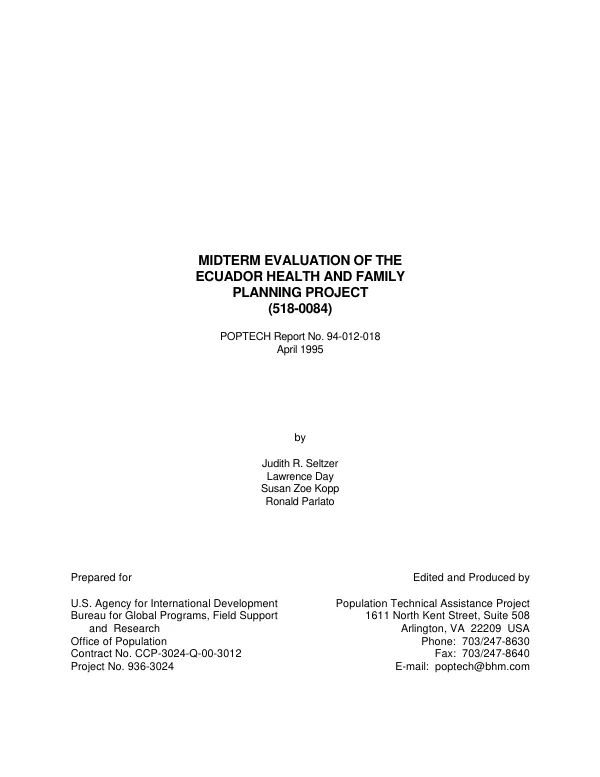
Midterm evaluation of the Ecuador health and family planning project (518-0084)
Evaluates project/program to improve family planning (FP) services in Ecuador.
Seltzer, Judith R.|Day, Lawrence · 1995
Sign in to readA free account is required to download.
Abstract
Mid-term evaluation assesses (1) the progress of two NGOs -- the Asociacion de Pro-Bienestar de la Familia Ecuatoriana (APROFE) and the Centro Medico de Orientacion y Planificacion Familiar (CEMOPLAF) and (2) nonproject assistance (NPA) to promote population policy and service delivery reforms. Evaluation covers the period 1991-4/95. Both NGOs have responded fully to the project's objectives, as of 1994 providing FP services to nearly 28% of contraceptive users (and supplying IUDs to 50% of IUD users.) Both are providing high quality care, through increased technical knowledge, improved interpersonal communication skills, and a new familiarity with counseling, and are making available a growing number of methods at conveniently located centers. The range of their reproductive health services includes FP and obstetrical and gynecological care, e.g., prenatal care, ultrasound, colposcopy, and reproductive tract infection diagnosis and treatment (which should be given more attention given the endemic nature of these infections) and general health services. Other planned outputs (strategic planning, cross-subsidization, and a means testing and exoneration system) are in place. The NGOs have strong IEC programs. APROFE has a well-diversified program consisting of mass media, interpersonal communications programs, special projects for women and youth, and a well-developed research component. CEMOPLAF manages a well-organized and ambitious program which includes mass media, print materials, and interpersonal education, targeting primarily rural populations. The NGOs have received good-quality TA from Johns Hopkins University (JHU), although there is room for improvement, and radio programming may cease when funds from JHU's contract are exhausted. The two NGOs have sound accounting systems and both are on track in terms of financial sustainability and cost recovery. Expectations are that they will recover 42%-45% of direct and indirect clinical service costs in 1994, with non-FP services already subsidizing clinical and community-based FP delivery. However, cost recovery has not been achieved without a price: both organizations have experienced a decline in new and continuing FP users as greater emphasis has been placed on non-FP services. This consequence may also be affecting FP delivery to poorer clients, although there is no information to determine the client profiles at either NGO. The NGOs and USAID need to resolve the conflict between the two project objectives of (1) cost recovery toward financial sustainability; and (2) extending availability to underserved populations. The NPA component has resulted in some policy changes, although these have been slow and minimal due to: Peru's the change to a more conservative government in 1992; lack of high-level support and consistent leadership; loss of USAID leverage when a $70 million health sector loan was approved one year after this NPA program began; lack of understanding as to how the NPA was to be implemented; bureaucratic inertia; inability of the Ministry of Finance to facilitate NPA implementation; and the passive role of USAID management once the political climate changed and problems were encountered. It appears that there has been virtually no impact on or improvement in service delivery by public sector agencies. although there have been improvements in some inputs, such as training.