USAID DEC
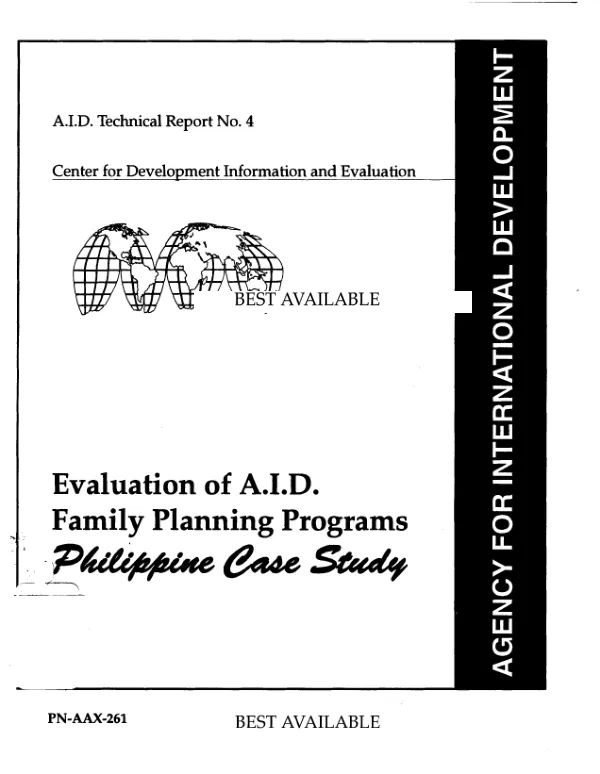
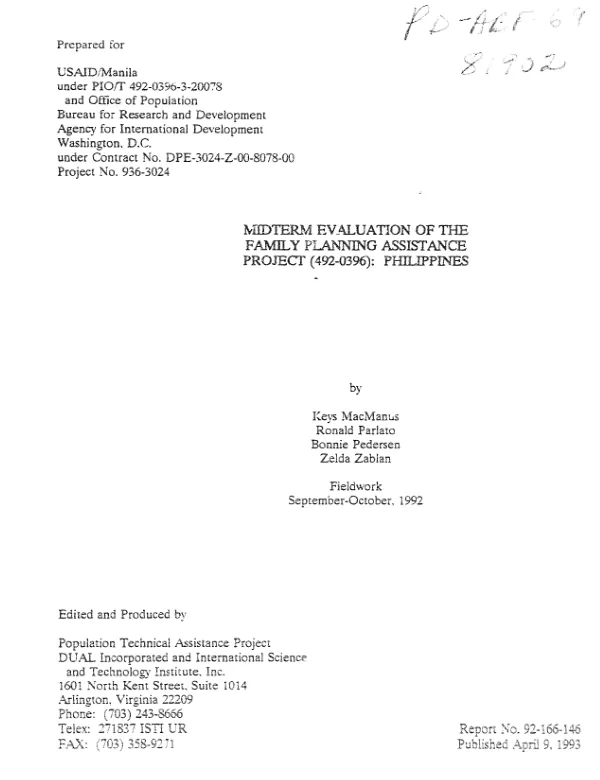
Midterm evaluation of the family planning assistance project (492-0396) : Philippines
Sign inDUAL & ASSOCIATES, INC.
Midterm evaluation of the family planning assistance project (492-0396) : Philippines
Evaluates project to support the Philippine Department of Health's (DOH) Philippine Family Planning Program (PFPP).
MacManus, Keys|Parlato, Ronald · 1993
Sign in to readA free account is required to download.
Abstract
Midterm evaluation covers 5/90-10/92. PFPP is seriously flawed, the result of nearly 10 years of disarray and lack of consistent support. During the 1970s and early 1980s, the Philippines had one of Asia's most successful FP programs, but then difficulties arose due to a decline in political support, economic stagnation, and increasingly strong opposition from the Catholic Church. Between 1987-89, PFPP's very existence was questioned. The Population Commission (POPCOM) was stripped of its responsibilities for FP, and the Department of Health (DOH), which took over the provision of services, totally ignored the NGO sector, which had provided 35% of services and a large share of IECM (information, education, communication, and motivation) and training. Without POPCOM and a strong NGO sector, PFPP was unable to meet demand, and currently the contraceptive prevalence rate (modern methods) in the Philippines is only 22%, well behind Thailand, Indonesia, and even Bangladesh. Efforts to find administrative solutions through the creation of a DOH Technical Secretariat (TS) backfired: the result has been that PFPP now speaks with two voices, that of TS and that of DOH's FP Services. This lack of direction will become even more critical with the recent decision to decentralize many government activities. More positively however, the USAID project has made an important contribution toward moving the DOH to reorganize and to recommit to FP. PFPP has ambitious plans for increasing contraceptive use, although due to the poor DOH management information system, actual service statistics are not known. The number is believed to be rising, but growth is deterred by limited contraceptives choice (Depo-Provera, Norplant, and progestin-only orals are virtually unavailable), poor service quality, and lack of coordination with basic health services. NGOs manage only about 17% of FP clinics now, the major constraint being a 1990 TS requirement that all NGOs be reaccredited; 3 years later, the status of many of the largest and best-established NGOs remains in limbo. Other constraints on NGOs are lack of training, funding delays, poor logistics support, and TS's failure to include NGOs in FP policymaking. Of two private sector efforts, an employer-based project shows promise, while a condom social marketing program is too new to assess. PFPP's plan to train 50,000 clinical personnel is progressing acceptably in the DOH but not at all in the NGOs, even though 60% of the training was to be directed to this sector. Other areas of concern include lack of a coherent training strategy, poor coordination among public and private providers, incomplete course guidelines, and overly restrictive clinical standards. IECM efforts are marked by the lack of a targeting strategy, Also, despite the importance of interpersonal communication in the Philippines, little progress has been made in incorporating outreach workers into IECM or in training clinical staff, especially midwives, to provide personal FP counseling. POPCOM has carried out successful advocacy efforts at the regional level, but these will have to be extended to local officials. The dearth of good service delivery data is a serious problem; the DOH MIS still remains largely on the drawing board, and the TS has made no effort to incorporate NGO data. In other areas, PFPP conducted no operational research, and its logistic system, though improved under the project, still needs work. Detailed recommendations are presented for restructuring and strengthening DOH management, reactivating the NGO sector, and energizing service delivery, training, and IECM.