USAID DEC
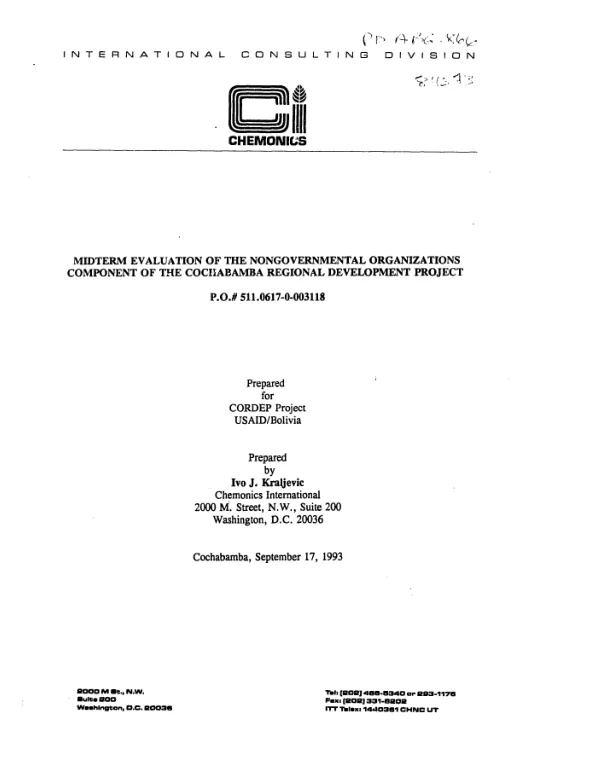
Midterm evaluation of the nongovernmental organizations component of the Cochabamba regional development project
Sign inCHEMONICS INTERNATIONAL, INC.
Midterm evaluation of the nongovernmental organizations component of the Cochabamba regional development project
Evaluates the NGO component, implemented by Planning Assistance (PA), of a project to develop alternative employment to coca-growing in Bolivia's Department of Cochabamba.
Kraljevic, Ivo J. · 1993
Sign in to readA free account is required to download.
Abstract
Midterm evaluation covers the period 12/91-9/93. The project's focus on income increases and/or job creation has led to the emergence and consolidation of a new type of NGO -- one that specializes in agricultural technology transfer and provides inputs to the small farm sector. Neither the state nor the private for-profit sector have a significant presence in either activity or in the sector. The Government of Bolivia could use this component as a model for a new national system for agricultural technology transfer as it reorganizes the Institute of Agricultural Technology (IBTA). To date, more than 20 NGOs have received project grants and have provided TA to more than 6,500 families (over 1,100 in the Chapare); almost 600 pilot projects have demonstrated production technologies and/or new crops in the zone; over 12,000 people (78% men and 22% women) have received short courses or on-the-job training in agriculture and livestock production technologies, soil and water conservation, accounting, credit operation, and crafts. Yields per ha have increased significantly, in some cases doubling or tripling, through the use of high quality seeds (not even certified seeds), new varieties, improved technologies, and the unadulterated inputs provided by the NGOs. Although net incomes have increased, along with yields per ha, long-term improvement in quality of life will not be determined until these increases can be sustained for some time. For this, farmers will require continued access to production inputs and TA. As NGOs are currently the only source of TA in most project areas, it is advised that the project revise its strategy to encourage NGO self-sufficiency and extend the life of the component, which is scheduled to end in June 1994. PA administers the component through a well-designed, very detailed system, and is generally respected by NGO staff. Complaints, few in number, seem to have centered not on technical or administrative issues, but on occasional overzealous project supervision. If the component is extended, PA will be well-suited to continue its implementation. On a broader scale, the NGO component would benefit if the many agencies involved in project implementation were to reach a consensus regarding the NGO component's purpose and implementation and adopt Integrated Product Development Plans (IPDP) as their guide to action.