USAID DEC
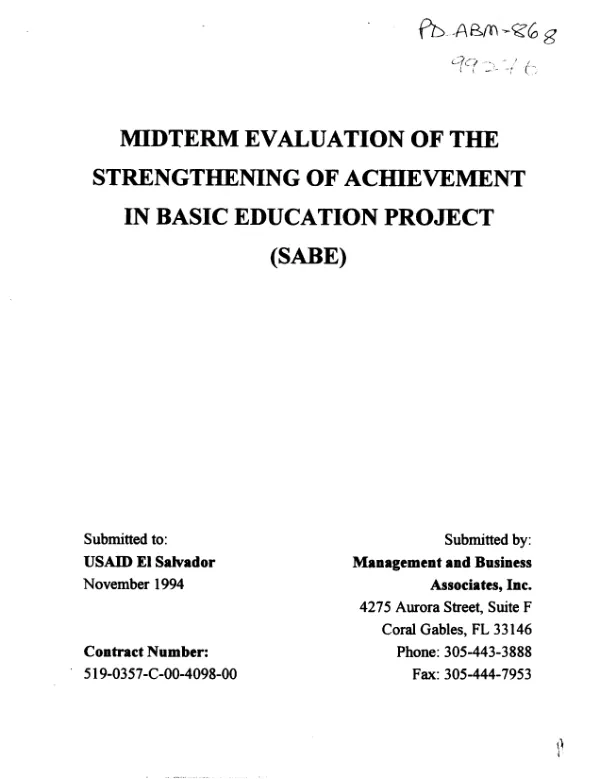
Midterm evaluation of the strengthening of achievement in basic education project (SABE)
Sign inMANAGEMENT BUSINESS ASSOCIATES
Midterm evaluation of the strengthening of achievement in basic education project (SABE)
Evaluates project to improve El Salvador's basic (K-6) educational system (SABE project).
Green, Charles B.|Acosta, Rolando · 1994
Sign in to readA free account is required to download.
Abstract
Mid-term evaluation covers the period 7/91-11/94. The project has been through rough times, but is now on track. Start-up was very difficult due to social upheaval caused by the civil war, and the constant turnover of long-term contractor personnel, which sapped the project's vitality and forced USAID/ES to manage the project forcefully and make decisions directly with the Ministry of Education (MOE), causing tensions among all three parties. Fortunately, the USAID/ES Education Office was up to the task, and with the MOE, guided the project through very demanding times. The contractor has now hired an extremely well-qualified Project Director, and the originally intended shared leadership among the MOE, the contractor, and USAID has slowly but fully been restored. The damage caused by the turnover in long-term advisors was most strongly felt in three areas: problems with commodity distribution; uncertain implementation of Component IV (educational development in the ex-conflictive zones); and the decreased learning capacity of the contractor, who had to rely inordinately on short-term advisors. Component IV was created by Amendment 2 to facilitate the peace agreement, yet little progress was made in implementation -- some think this is due to political issues between ARENA, the governing party, and FLMN, the national liberation front; others say the Amendment's translation into Spanish was ambiguous; still others feel that USAID could have interpreted Amendment 2 more flexibly. However, no matter what the cause of the delay, implementation seemed to be picking up as of June 1994. The project has now overcome most of its early problems and is creating a significant and visible impact on El Salvador. Teacher training, curriculum development, educational testing, and the writing, printing, and distribution of texts are at once impressive as well as on target with logframe objectives. There are still problems, but the MOE, the contractor, and USAID are working more cooperatively than ever to confront and resolve them. The commodity distribution system is a serious problem. Recommendations are to keep commodities in a central warehouse where they can be carefully controlled by a system. The most important lesson learned concerns the selection and recruitment of long-term personnel who are appropriate and well suited for the task. However, it is not clear what type of due diligence on background checks is sufficient and legal with respect to the federal law that guides this process. Secondly, starting too big too fast is a concern for the future when infrastructural development outpaces stable project leadership.
Related documents