USAID DEC
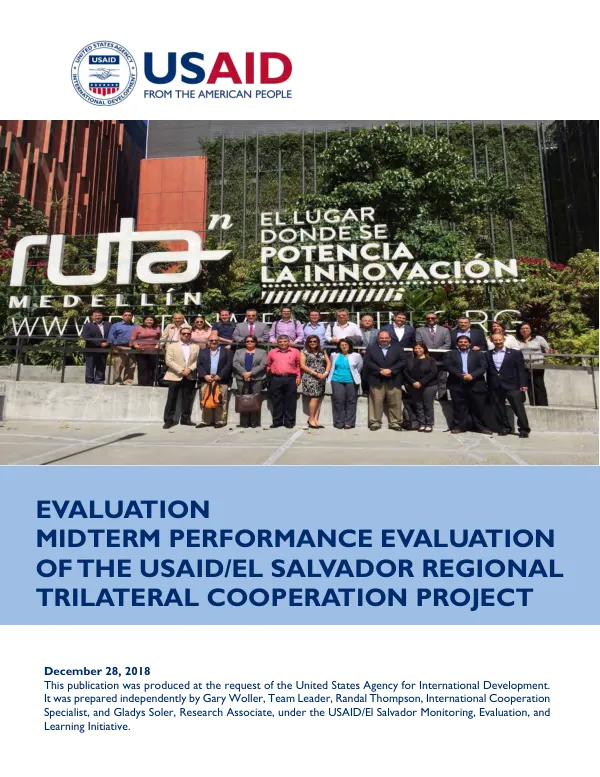
Midterm performance evaluation of the USAID/El Salvador regional trilateral cooperation project
Sign inME&A
Midterm performance evaluation of the USAID/El Salvador regional trilateral cooperation project
The Regional Trilateral Cooperation (RTC) project supports building trilateral cooperation between the United States Government (USG), provider countries in Latin America, and Northern Triangle countries in Central America.
Woller, Gary; Thompson, Randal +1 more · 2018
Sign in to readA free account is required to download.
Abstract
Together, these entities can support the technical expertise and knowledge transfer, while building and strengthening collaborative intra-regional relationships. The RTC midterm performance evaluation examined 1) efficiency of project resource use, 2) whether collaborative relationships exist and are sustainable, and 3) how recipient countries use their new knowledge. The evaluation concludes that the trilateral exchanges facilitated by RTC have produced several important benefits including knowledge gained and applied, and cooperative relationships strengthened or formed with counterparts in the recipient and provider countries. These relationships have mostly endured and providers and recipients expect them to continue to endure—at least as contingent assets, if not as ongoing, active relationships. As a mechanism for facilitating, incentivizing, and demonstrating the value of trilateral exchanges, RTC has been highly effective. However, the effectiveness has been at a high a cost relative to other possible approaches for facilitating trilateral cooperation. Its perceived cost-effectiveness and value-added are constrained by its primary role as a logistical support project, although it may take on more roles to increase its value-added. Whether USAID/El Salvador should continue RTC into its option year depends on whether it can expand RTC’s current role and add more value.