HAGLER BAILLY SERVICES, INC.
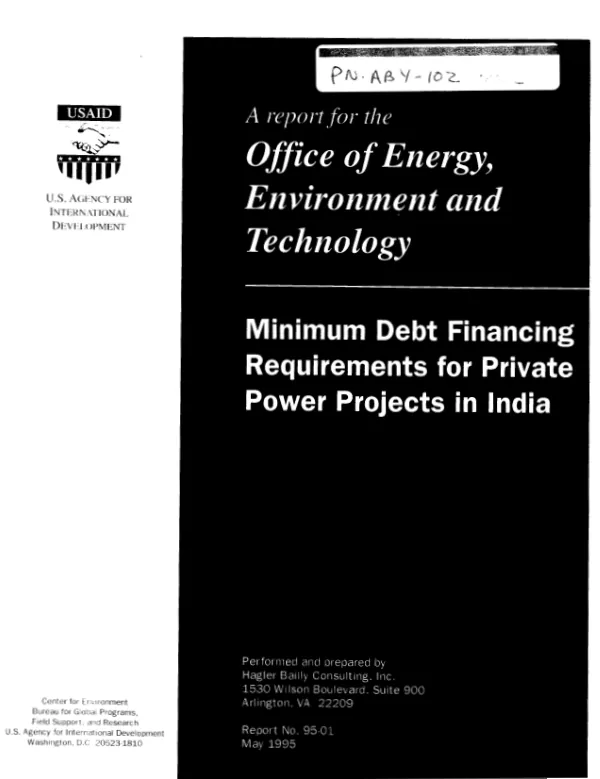
Minimum debt financing requirements for private power projects in India
India"s rapid economic growth is placing major demands on the largely government-owned and -operated power sector.
Buresch, Matthew; Dalal, Amit R. · 1995
Sign in to readA free account is required to download.
Abstract
Because the government resources available to meet these demands are limited, attention is increasingly being paid to attracting private investment, both domestic and foreign. This report examines the minimum requirements for debt financing in India, as well as options for expanding private power investment. Following an introduction to the Indian power and financial sectors, Chapter Two gives a brief overview of the U.S. project investment cycle, which is used by most power developers active in India; lender requirements are also discussed. Chapter Three describes the characteristics of participants (equity and debt holders) in private power projects elsewhere in Asia and the experience of private power projects that are under construction. Chapter Four reviews the major risk concerns and management requirements of those who provide debt financing for power projects in India, presenting a framework for understanding project investment and lenders" credit review processes. Chapter Five evaluates options and recommendations for increasing debt financing in India"s power sector. The chapter briefly examines the 7 fast-track independent power projects (IPPs)that have or are expected to receive Government of India (GOI) counter-guarantees (Enron"s Dabhol project is viewed in greater detail to help determine whether it could serve as a model for future project development). Next, in light of the GOI"s stated intention to eliminate counter-guarantees after they have been granted to the first-track projects, 7 near-term alternatives to guarantees are presented: World Bank guarantee, export credit agency guarantees, major Indian bank financing and guarantees, state government guarantees, escrow account with industrial receivables, power wheeling to major industrial customers or direct industrial generation, and corporate balance sheet financing. Options for linking guarantee alternatives to the longer-term reform process are presented in conclusion.
Related documents
![ECO, energy conservation and commercialization project : report on identification of EE [energy efficiency] projects](https://covers.devme.ai/gen/83511.webp)
![Globalization and the WTO [World Trade Organization] agreement on financial services in African countries](https://covers.devme.ai/gen/83561.webp)