USAID. BUR. FOR POLICY AND PROGRAM COORDINATION. CENTER FOR DEVELOPMENT INFORMATION AND EVALUATION (CDIE)
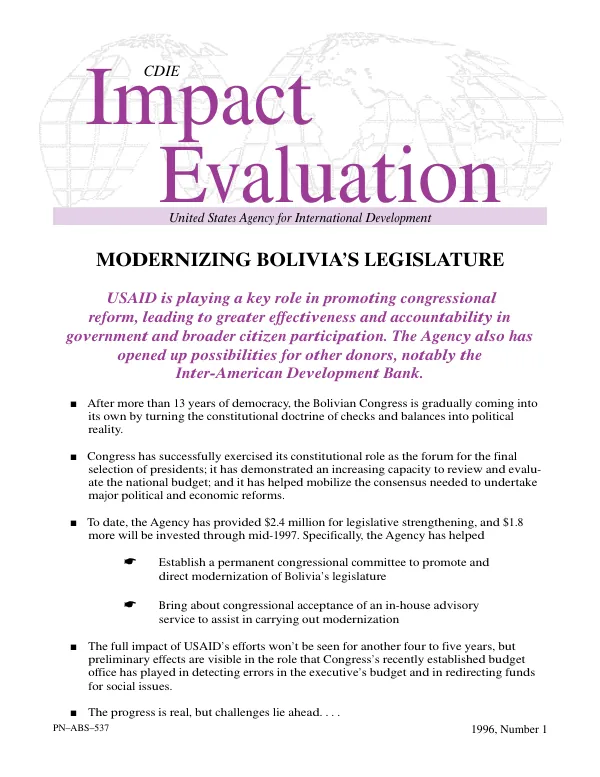
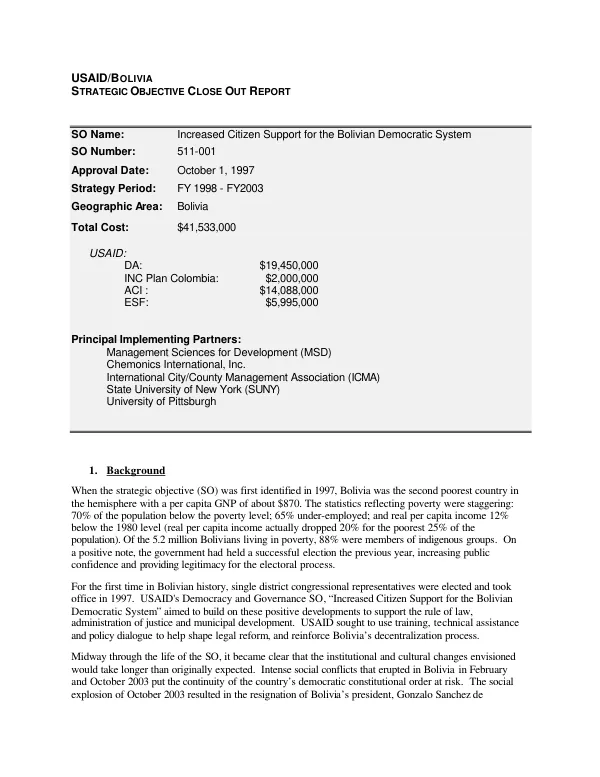
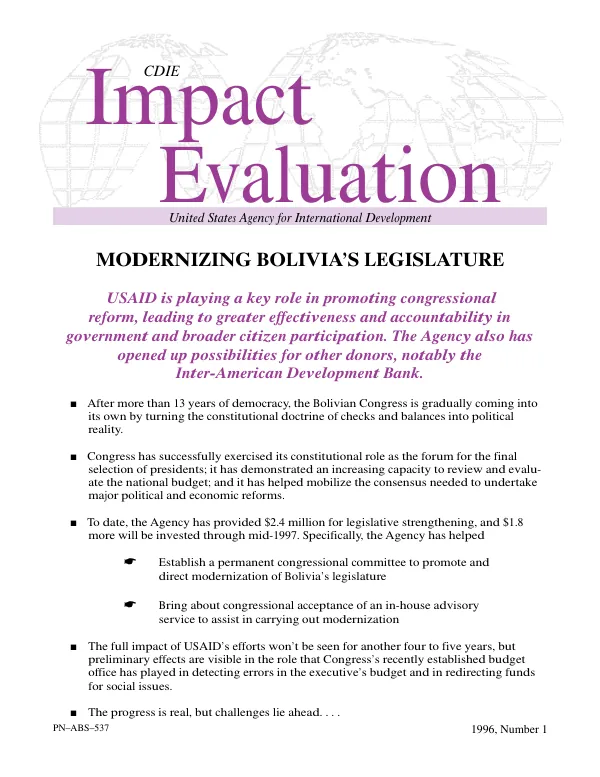
Modernizing Bolivia's legislature
After more than 13 years of democracy, including three peaceful and democratic transfers of power, the Bolivian Congress is gradually turning its constitutional doctrine into a political reality: it has finalized the selection of presidents, shown an increasing capacity to review and evaluate the national budget, and reviewed and approved legislation enabling economic and political reform.
Bernbaum, Marcia|Anderson, John · 1995
Sign in to readA free account is required to download.
Abstract
USAID/Bolivia has promoted this development, since 1992 providing $2.4 million for training, TA, institutional development, and operating expenses, with another $1.8 million planned for 1996�97. Specifically, during the past 2 years, the Agency has helped the Bolivian Congress: (1) establish a permanent congressional committee to direct the modernization of Congress; (2) approve the National Congressional Research Center, an in-house advisory service (analogous to the U.S. Congressional Research Service), to assist in carrying out modernization; and (3) create, through an arm of the State University of New York, the Technical Office of the Budget (OTP). (Corresponding to the U.S. Congressional Budget Office, the OTP is bringing about greater government accountability and transparency. In 1994, for example, it brought to light an error, subsequently corrected by the Ministry of Finance, of 200 million bolivianos (approximately US$43 million) in the 1995 budget. To ensure the sustainability of progress achieved, USAID/Bolivia has helped the Inter-American Development Bank develop and fund its own complementary program to help modernize the Bolivian congress. Recent congressional approval of $500,000 to fully fund the National Congressional Research Center in 1996 augurs well, although challenges remain. Lessons for donors include the following. (1) Regularly assess progress and risks, and modify strategies or activities to accommodate the ever-changing political climate. (2) As an external entity in a sensitive political atmosphere, it pays to remain low-key and neutral. (3) Have at least one staffperson who is "plugged in," knows key actors in the legislature, and can operate within a highly charged political environment. (4) Assess the state of political development of the legislature being supported from day one and keep an accurate chart of its progress. (5) Stay small until there is evidence of sufficient interest within the legislature to ensure a commitment to change. (6) Foster multipartisan political commitment early on. (7) Identify a primary area for initial attention and provide needed information and skills on a timely basis. (8) If providing support up front for operating costs, weigh the associated risk for sustainability. (9) Ensure that the initiatives proposed are fully endorsed by high-level officials. (10) It is useful to take steps to assist legislatures through both internal and external channels. (11) Donor coordination is critical. (Author abstract, modified)