USAID DEC
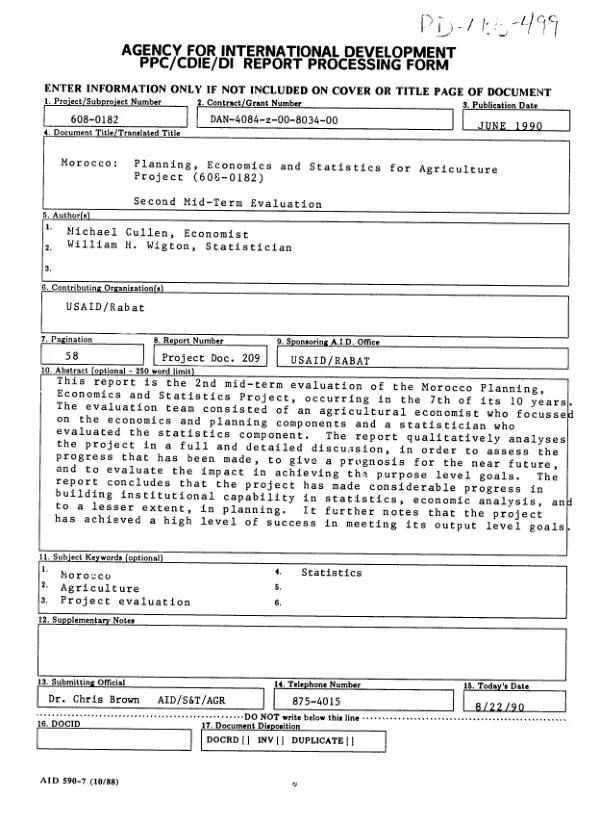
Morocco : planning, economics and statistics for agriculture project (608-0182) -- second mid-term evaluation
Sign inABT ASSOCIATES, INC.
Morocco : planning, economics and statistics for agriculture project (608-0182) -- second mid-term evaluation
Mid-term evaluation of a project to improve policy analysis and decisionmaking within Morocco"s Ministry of Agriculture and Agrarian Reform (MARA).
Cullen, Michael; Wigton, William H. · 1990
Sign in to readA free account is required to download.
Abstract
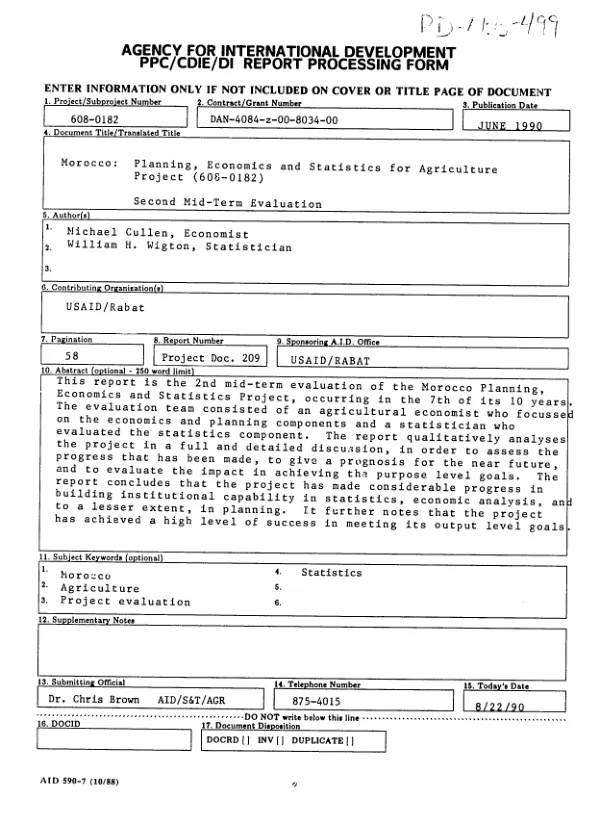
Evaluation covers the period 1983-1990. The project has made considerable progress in building institutional capability in statistics, economic analysis, and, to a lesser extent, in planning. Nearly all output level goals have been met. Under the statistics component, the project established an aerial frame sampling system covering all the nation"s agricultural land. Specified surveys are undertaken regularly and the results published, an aerial photo lab is operating, and computerization is underway for field offices. The system provides data of critical importance to government decisionmakers and is a model for FAO and Francophone countries. The institutional capability to provide the necessary economic analysis for policy making has been put in place. MARA staff have produced economic studies of reasonably good quality as a result of project training in computers, economic theory, data base management, econometrics, and research. Progress in planning is less noteworthy since the component was just added in 1988. Nearly all questions regarding the sustainability of the project relate to the management of MARA"s Directorate of Planning and Economic Affairs (DPAE). The DPAE is faced with a conflict between short-term information requests from a diversity of sources and the mandate to conduct medium- or long-term research; DPAE has issued no clear statement of priorities regarding this matter, and resources are routinely shifted on an ad hoc basis to meet the need at hand. More generally, performance criteria are lacking, there is no precise allocation of time or budgetary resources, and planning is virtually non-existent. That the organization lacks cohesiveness is evident in the fact that publications are not regularly distributed, interaction among staff members is limited, training and perquisites are allocated in a subjective fashion, recognition for work is not always given, and morale and motivation are not consistent. These problems also raise questions regarding DPAE"s capacity to absorb the 24 staff members who will be returning from long-term U.S. training.
Related documents