USAID DEC
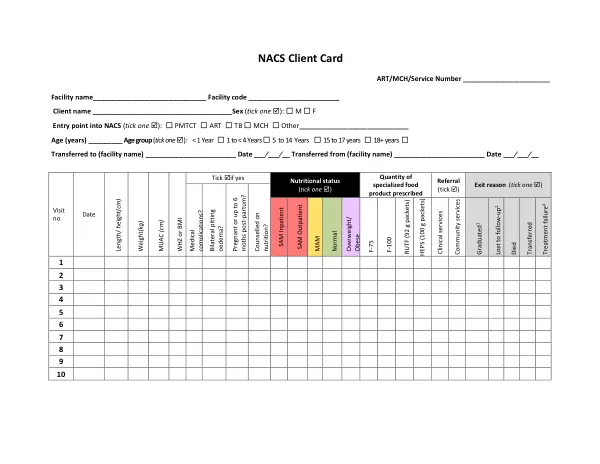
NACS Client Card
The NACS Client Card is a standardized form used to record client information and track their progress through the National AIDS and Sexually Transmitted Infections Control Program (NACS).
2020 · 1 pages
Sign in to readA free account is required to download.
Abstract
The form captures essential demographic data, including client name, sex, age, and age group. The entry point into NACS is also recorded, with options including Prevention of Mother-to-Child Transmission (PMTCT), Antiretroviral Therapy (ART), Tuberculosis (TB), Maternal and Child Health (MCH), and other services. Client information is also used to track their nutritional status, with measurements including length/height, weight, mid-upper arm circumference (MUAC), and weight-for-height or body mass index (WHZ or BMI). The client's nutritional status is categorized as severe acute malnutrition (SAM) inpatient, SAM outpatient, moderate acute malnutrition (MAM), normal, overweight/obese, or underweight. Specialized food products, such as F-75 and F-100, are prescribed based on the client's nutritional needs. The form also captures information on clinical services provided, including referrals and medical complications. Bilateral pitting oedema is recorded, as well as pregnancy status and post-partum counseling on nutrition. Community services, such as graduated care, lost to follow-up, and transferred care, are also documented. Treatment failure is recorded as an exit reason. The NACS Client Card is used to track client progress and provide essential information for program management and evaluation. The form is designed to capture a range of data, including demographic information, nutritional status, and service utilization. By analyzing this data, program managers can identify trends and patterns, inform program decisions, and improve client outcomes. The form is used in various settings, including health facilities and community-based programs. The data collected on the NACS Client Card is used to inform program planning, resource allocation, and service delivery. The form is an essential tool for program management and evaluation, enabling program managers to track client progress and make data-driven decisions. The NACS Client Card is an essential tool for program management and evaluation, enabling program managers to track client progress and make data-driven decisions. The form captures a range of data, including demographic information, nutritional status, and service utilization, which is used to inform program planning, resource allocation, and service delivery. By analyzing this data, program managers can identify trends and patterns, improve client outcomes, and inform program decisions.