ERNST & YOUNG
National export plan for Guatemala : `Guatemala mil millones" -- final report
Throughout most of the 1960"s and 1970"s, Guatemala experienced relatively rapid economic growth within the protective tariff barriers of the Central American Common Market.
1990
Sign in to readA free account is required to download.
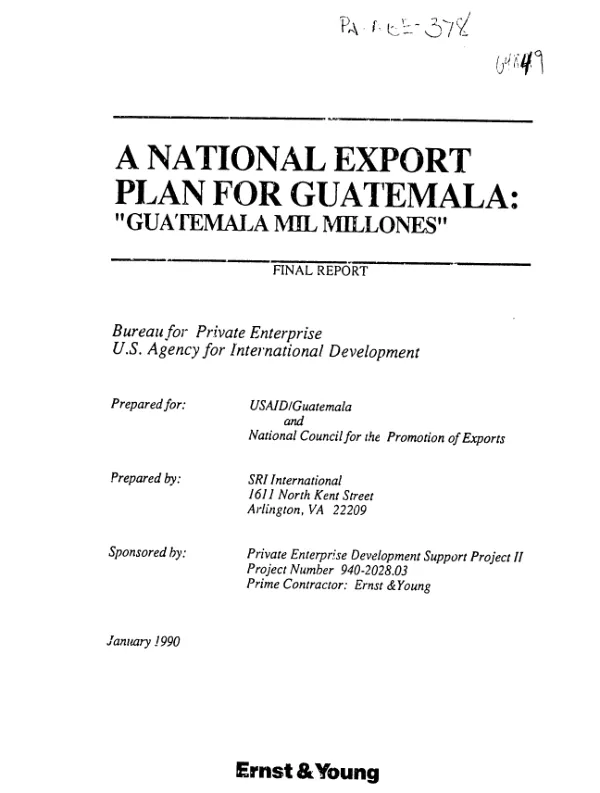
Abstract
Since 1980, however, this protected market has collapsed as the result of economic deterioration in the politically unstable countries of Nicaragua and El Salvador. Guatemalan exports to Central America have declined by over 60%, or almost 3.5% of GDP. The plan outlined herein aims to refuel Guatemala"s economy by gradually reducing the anti-export bias inherited from several decades of import substitution. The plan - which is named Guatemala Mil Millones because it will enable Guatemala to reach $1 billion in nontraditional exports by 1995 - includes 45 specific recommendations. In the short term (1989-92), the plan calls for several programs to counteract the negative effects of current policies and economic institutions. These programs include special credit lines for exporters, effective and transparent duty-drawback and free-zone programs to ensure access of inputs at competitive prices and reduce costly bureaucratic procedures, and infrastructure improvements to facilitate transport and communication with world markets. In the medium (1993-96) and longer (1997-2000) terms, the plan emphasizes the importance of maintaining a stable, outward-oriented macroeconomic framework, including continued gradual reduction of effective protection rates.
Related documents
Documents in this collection
 1990
1990USAID DEC
Guatemala : products and markets for export growth
Open record![AID cooperative agreement no. 520-0403-A-00-3257-00 to Gremial de Exportadores de Productos No Tradicionales [Guild of Non-Traditional Product Exporters] to support policy reform, non-traditional export development and improved labor relations under the trade and labor relations development [TLRD] program](https://covers.devme.ai/gen/57604.webp) 1993
1993USAID DEC
![Cooperative Housing Foundation (CHF) : post-[Hurricane] Mitch reconstruction in the Ixan[, Guatemala] -- annual work plan for FY 2001](https://covers.devme.ai/gen/106706.webp)