USAID. BUR. FOR PROGRAM AND POLICY COORDINATION. OFC. OF EVALUATION
New directions : rural roads
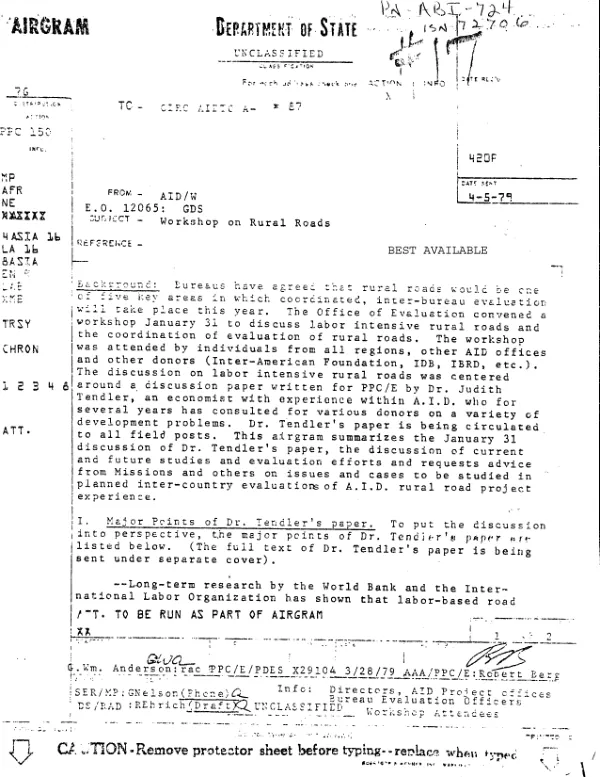
In order to increase the impact of road projects on the rural poor, emphasis has gradually shifted from paved highways to rural roads and from capital-intensive to labor-intensive construction methods.
Tendler, Judith · 1978
Sign in to readA free account is required to download.
Abstract
The author of this paper analyzes the benefits of the labor-intensive approach and the options A.I.D. can pursue to encourage its use. Various research findings on the cost-effectiveness and employment-generating potential of labor-based construction are reported. Several reasons are given for the continued preference of host countries and contractors for capital-intensive designs despite these findings. One simple reason is that both donors and developing country governments are more accustomed to working with equipment than with labor management. In fact, donor requirements for financing tend to encourage adoption of the capital-intensive mode. However, rural road construction, which is increasingly frequent, is more conducive to the labor-based mode than are highway or paved road projects. Since most central government highway departments lack the capabilities needed to manage labor-intensive rural road projects and have maintained a high priority on arterial road construction, A.I.D. should resist pressure to invest in the latter, investigate possibilities for complementary rural road construction, and remove management of such projects from national highway departments. Site selection criteria are discussed and recommendations are made to facilitate the adoption of labor-based construction. By refraining from subsidizing equipment costs and by seeking more acceptable environments, A.I.D. will lessen the relative costs of such techniques. It is emphasized that decentralized management can increase the political appeal of such projects and improve the chronic problem of maintenance, particularly use of the "no-maintenance model" (paving roads before the volume of traffic warrants the investment). Finally, to improve A.I.D.'s rural road policy, it is recommended that a country's road system be examined in its entirety rather than project by project and that community-based construction, including participation in road financing, be encouraged. A 94-item bibliography (1966-78) is attached.
Related documents