USAID. MISSION TO NIGER
Niger family health and demography
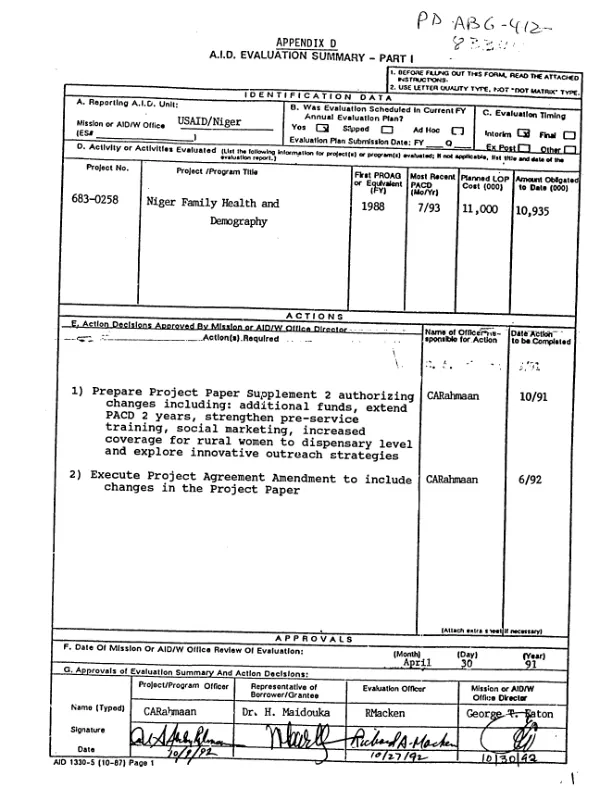
Summarizes attached interim evaluation (XD-ABG-412-A) of a project to expand family planning (FP) and demographic research programs in Niger.
1992
Sign in to readA free account is required to download.
Abstract
The evaluation covered the period 8/88-3/91. Considerable progress has been made in strengthening the capacity of the Directorate of Family Planning (DFP) to implement a national FP program. The DFP has significantly improved its performance in the areas of program management and planning, technical training, production of IEC materials, and contraceptive logistics and supply. The DFP has also assured effective coordination with other concerned ministries as well as with international donors. FP services are now available in maternity wards, maternal/child health (MCH) centers, and major health clinics in each of the country"s 39 district medical centers, with the number of FP service points rising from 89 to over 140 between 1988 and 1990. This increased availability has been a key factor in the near doubling of couple-years of protection (from 20,000 to 38,000) in the same period. There are several areas of concern, however. (1) To achieve a contraceptive prevalence rate of at least 7% among women, efforts must be extended beyond the largely urban-based facilities originally targeted under the project to include health posts, dispensaries, and community-based systems in rural areas. This would require bolstering the Community Health Workers program, which is very weak. (2) There is also a need to improve the integration of FP and MCH services (DFP being organizationally distinct from the Ministry of Public Health) and to strengthen and accelerate technical training and IEC efforts. Increased support for private sector initiatives, especially in contraceptive social marketing, is also called for in the light of the government"s relaxation of opposition to private contraceptive sales. In the second project component, significant TA from the U.S. Census Bureau and short-term training interventions have helped the Directorate of Statistics and Demography (DSD) complete the processing of the 1988 census and complete preparation work for the 1992 census. The project is also assisting the DSD in formulating a national population policy -- a major contribution to project objectives. Other efforts have fallen behind schedule, however, and institutional weaknesses remain in both DSD and its parent ministry. Specifically, the DSD has poor working conditions (space and equipment) and an inadequately trained staff, suffers from poor or confused planning, and lacks a program to develop the documentation center and a regional capacity to obtain and use demographic data for planning and programming purposes. As a result of the evaluation, the Mission prepared a Project Paper amendment incorporating evaluation recommendations addressing the aforementioned problems.
![Executive summary [: midterm evaluation of the Niger family health and demography project]](https://covers.devme.ai/gen/7942.webp)