UNIVERSITY OF FLORIDA. INSTITUTE OF FOOD AND AGRICULTURAL SCIENCES
NITROGEN FIXATION IN GRASSES; ANNUAL REPORT, 1977
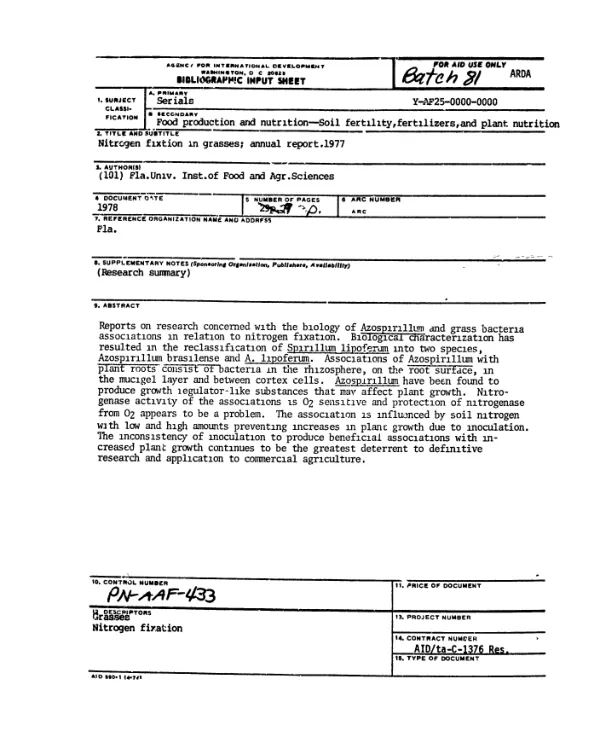
Reports on research concerned with the biology of Azospirillum and grass bacteria associations in relation to nitrogen fixation.
1970
Sign in to readA free account is required to download.
Abstract
Biological characterization has resulted in the reclassification of Spirillum lipoferum into two species, Azospirillum brasilense and A. lipoferum. Associations of Azospirillum with plant roots consist of bacteria in the rhizosphere, on the root surface, in the mucigel layer and between cortex cells. Azospirillum have been found to produce growth regulator-like substances that may affect plant growth. Nitrogenase activity of the associations is O2 sensitive and protection of nitrogenase from O2 appears to be a problem. The association is influenced by soil nitrogen with low and high amounts preventing increases in plant growth due to inoculation. The inconsistency of inoculation to produce beneficial associations with increased plant growth continues to be the greatest deterrent to definitive research and application to commercial agriculture.
Connected topics
![Annual report covering period [January 1 to December 31, 2004] [i.e. January 1 to December 31, 2003] : saltgrass (Distichlis spicata) -- a new salt-resistant forage crop for the reclamation of salinized soils](https://covers.devme.ai/gen/23665.webp)