USAID. MISSION TO ZAIRE
North Shaba rural development
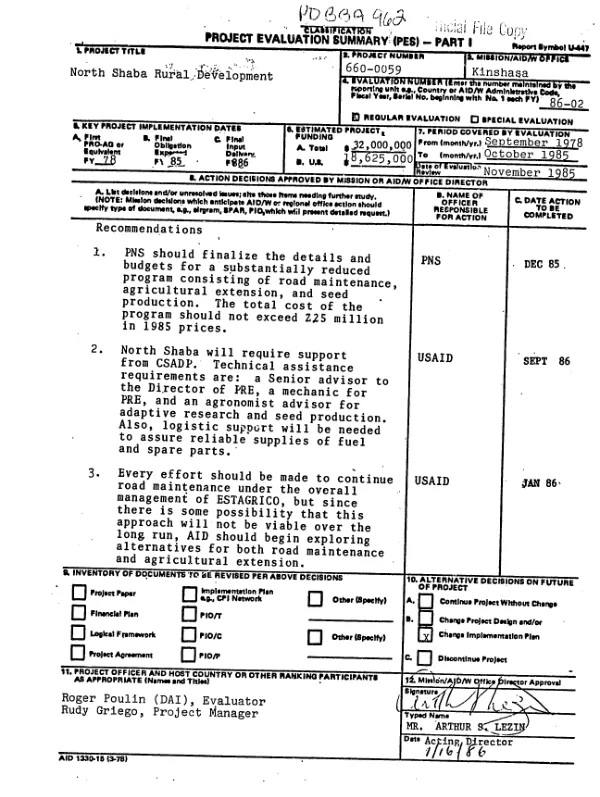
Summarizes attached mid-term evaluation (XD-BBA-962-A) of an integrated rural development (IRD) project in North Shaba, Zaire.
Poulin, Roger; Griego, Rudy · 1986
Sign in to readA free account is required to download.
Abstract
The evaluation covered the period 9/78-10/85; no methodology is given. All quantifiable impact and output targets have been achieved, the quantity of maize marketed - 42,000 tons (55,700 according to data gathered subsequently by USAID/Z) in 1985 against a target of 30,000 - being the key indicator. Targets were also met or exceeded regarding the number of farmers using improved seed and receiving extension, the quantity of seed produced by the project, the decline in the rate of subsidy, and the km of roads rehabilitated. Road maintenance, while officially integrated into ESTAGRICO, remains in practice an autonomous organization. The project and ESTAGRICO had a common extension program in 1984 but there has been no progress toward formal institutional integration. The essential development activities that must be continued after the project"s end - road maintenance, seed production, and extension - will require TA to maintain an acceptable level of performance. Several lessons learned were learned. (1) The essential requirements for a successful agriculture-based IRD project are a technology to increase small farmer production and a market to absorb the increased production. (2) Trying to do everything at once in IRD projects wastes money and diverts attention from the key goal of such projects - increasing small farmer production and incomes. Other interventions, such as self-help activities, social services, cooperative development, and off-farm employment generation, generally do not succeed without a strong economic base to build on. (3) It is extremely difficult to make IRD programs financially sustainable. Government budgets can rarely cover all road maintenance and agricultural extension costs, and even when a project succeeds in generating its own tax base, finding alternatives to government budgetary funding is bureaucratically and politically complicated. Even the most successful project must begin preparing for sustainability at the very outset and pursue this goal systematically and diligently. Mission comments on the evaluation, as well as several action decisions (the text is incomplete on the latter), are included.
Related documents