USAID. BUR. FOR SCIENCE AND TECHNOLOGY. OFC. OF NUTRITION
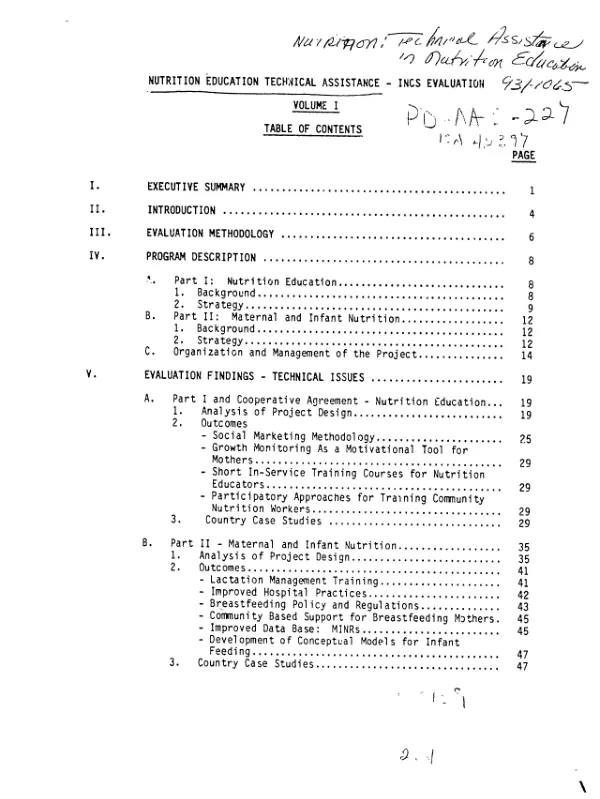
Nutrition education technical assistance - INCS evaluation
Evaluates project to support nutrition education and promote improved infant feeding practices.
Sign in to readA free account is required to download.
Abstract
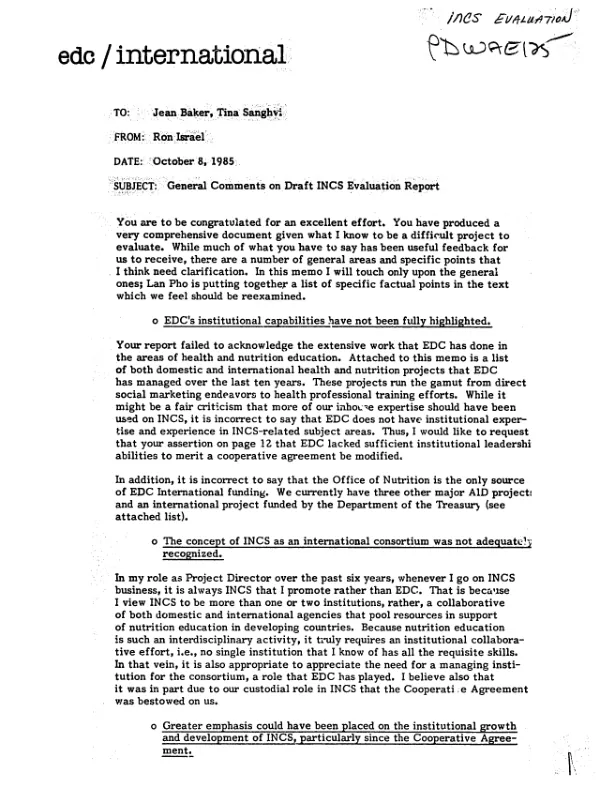
Special evaluation covers the period 9/79-9/85 and is based on site visits, document review, and interviews with Mission, AID/W, and International Nutrition Communications Services (INCS) personnel. Most targets have been met. INCS has provided TA in 35 countries, held 30 conferences and training workshops, provided about 120 person-months of training, and designed, initiated, expanded, or improved at least 20 nutrition education projects, of which at least 10 have shown preliminary indications of sustained changes. In addition, INCS has initiated, expanded, or improved breastfeeding promotion projects in about 12 countries (2 of these projects have demonstrated increased breastfeeding prevalence and decreased diarrheal morbidity) and has collected and analyzed improved information on infant feeding practices in four countries. As a result of these activities, new methodologies and techniques have emerged: a social marketing methodology appropriate for changing nutrition behavior, use of growth monitoring to strengthen behavioral change, and sensitization of hospital personnel to the advantages of breastfeeding. Three factors have prevented the project from having a greater impact: lack of continuity or follow-up regarding TA (due to unavailability of experienced consultants, poor communication with clients, inadequate promotion by A.I.D., and insufficient resources); inadequate knowledge among USAID's and PVO's regarding nutrition programming; and insufficient use of subcontractor and consultant expertise, e.g., for setting priorities and developing conceptual models and strategies. Due to inadequate funding for clearinghouse functions, INCS could only minimally support field needs in this area. The project should be continued, with greater flexibility to provide seed funding and longer-term TA, and priority given to (1) activities most likely to improve child survival and nutritional status (i.e., breastfeeding, growth monitoring, infant feeding during infections); (2) communications approaches (i.e., social marketing with strong monitoring mechanisms); and (3) program situations possessing sufficient commitment, resources, and infrastructure to sustain activities.
Related documents
![Achieving equity, coverage and impact through a care group network : Sofala Province, Mozambique, October 1, 2005-September 30, 2010, cooperative agreement no. GHS-A-00-05-0014-00 [i.e. GHS-A-00-05-00014-00] : mid-term evaluation](https://covers.devme.ai/gen/20208.webp)