USAID DEC
Nutrition situation and program assessment in Benin = Situation nutritionnelle au Benin
Sign inEDUCATION DEVELOPMENT CENTER, INC. (EDC)
Nutrition situation and program assessment in Benin = Situation nutritionnelle au Benin
The nutritional status of women and children in Benin is cause for serious concern.
Seumo, Eleonore · 1994
Sign in to readA free account is required to download.
Abstract
More than one-third of children less than three years of age have a weight for age ratio below 80% of the Harvard reference median; 10%-17% of these same children in 11 food insecure districts suffer from acute malnutrition as indicated by a weight for height ratio below 80% of the National Center for Health Statistics (NCHS) reference median. More than half of children 6 months of age or older are anemic. In the north, children also suffer from hypovitaminosis A. More than 14% of adolescent females suffer from malnutrition (body mass index lower than the point of reference). This state worsens during pregnancy. Almost 45% of pregnant women are anemic. Pregnant women and adolescent females are particularly affected by iodine deficiency disorders (IDD). More than half of the nursing mothers in southern Benin are anemic. Moreover, the full extent of nutritional problems among women and children in Benin, and the areas most affected are not known. During the first six months of life, 77.6% of children are breastfed. Only 7% are exclusively breastfed between 4 and 6 months of age. The introduction of weaning foods occurs generally around 3 months of age. Constraints to the practice and promotion of exclusive breastfeeding include: (1) the widespread belief that newborn babies are thirsty and need water and other liquids; (2) women"s heavy workload; (3) the non-availability of representative data on breastfeeding practices; (4) the state"s lack of funding for the promotion of breastfeeding; and (5) inadequate training of health care personnel and social welfare workers on the practice of exclusive breastfeeding. The feeding practices of women and children under 36 months of age, as well as the sociocultural factors influencing feeding practices and their impact on nutritional status, is not known. Most existing interventions focus on improving food availability; some activities try more directly to improve the nutritional status of children. None of the interventions specifically aim to improve women"s nutritional status. (Author abstract)
Related documents
Documents in this collection
 2002
2002USAID DEC
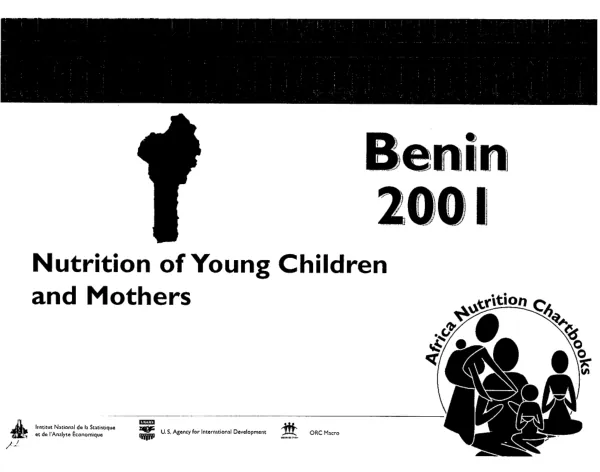
Nutrition of young children and mothers in Benin : findings from the 2001 Benin demographic and health survey = Nutrition des jeunes enfants et des meres au Benin : resultats de l"enquete demographique et de sante au Benin 2001
Open record![Nutrition and health status of young children and their mothers in Eritrea : findings from the 1995/96 Eritrea demographic and health survey [DHS]](https://covers.devme.ai/gen/32556.webp) 1999
1999USAID DEC
![Nutrition and health status of young children and their mothers in Mali : findings from the 1995/96 Mali demographic and health survey [DHS]](https://covers.devme.ai/gen/45157.webp)