KENYA AGRICULTURAL RESEARCH INSTITUTE
On-farm research and technology for dual-purpose goats
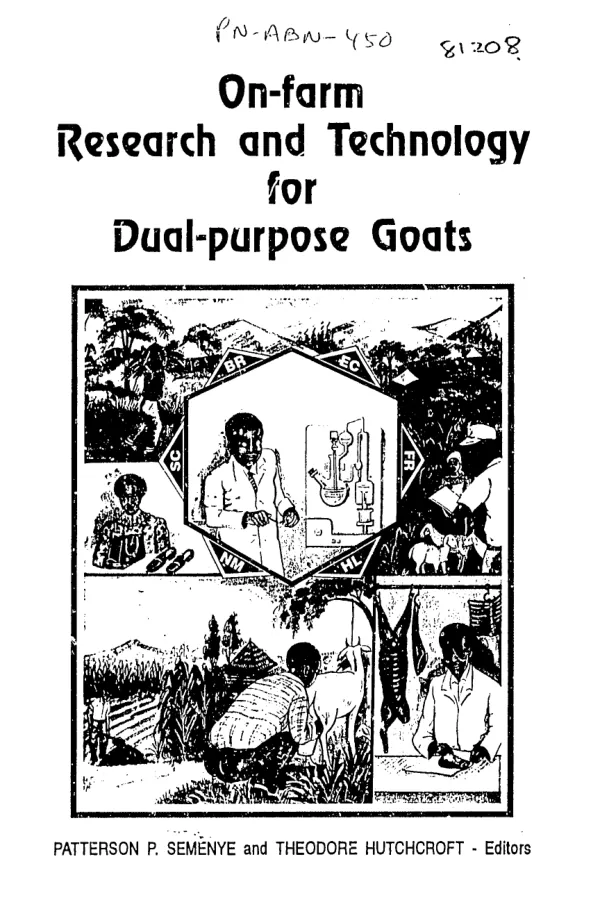
Dual purpose goats can increase productivity in small farming systems: they can convert unused crop residues to milk and meat, providing a small but year round supply of milk protein, and producing one or two kids a year, which can be either eaten or sold for cash income.
Semenye, Patterson P., ed.; Hutchcroft, Theodore, ed. · 1970
Sign in to readA free account is required to download.
Abstract
This manual, designed primarily for extension workers, reports recommendations developed in densely populated, medium- to high-potential agricultural areas of western Kenya. The opening chapters describe the agricultural development of western Kenya, the specific setting for smallholder agriculture, and on-farm research methodologies. Succeeding chapters describe: breeding strategies for genetic improvement, methods for developing and using forages, nutrition and goat production management, the treatment of common health problems, and the economic impact of adding dual purpose goats to a farm. A final chapter on farmers" acceptance of the goat technology introduced in western Kenya concludes that goat production is most popular in the highlands, where higher rainfall and acute population pressure favor intensified agriculture rather than in the lowlands, where the average farm is twice as large and rainfall only half much. This suggests the need for a dual technology package for dual purpose goat production.
Connected topics
![Compendium of ILRI [International Livestock Research Institute] research impacts and adoption 1975-1998](https://covers.devme.ai/gen/41089.webp)
![External evaluation panel report 1992 [: small ruminant collaborative research support program]](https://covers.devme.ai/gen/68117.webp)