USAID DEC
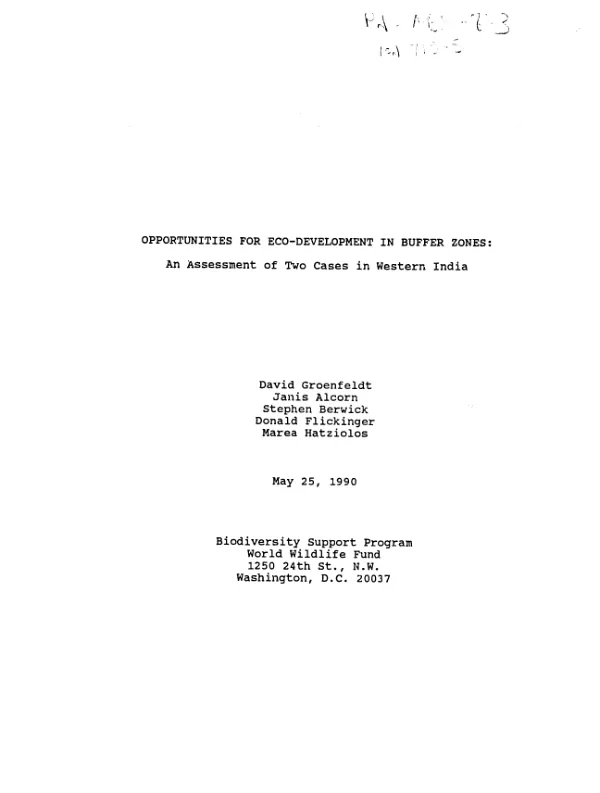
Opportunities for eco-development in buffer zones : an assessment of two cases in Western India
Sign inWORLD WILDLIFE FUND-U.S. (WWF-U.S.)
Opportunities for eco-development in buffer zones : an assessment of two cases in Western India
Throughout the world, wildlands are under constant pressure from surrounding populations who depend upon them for basic needs such as fuelwood, livestock grazing, and forage; the regions where wildlands meet human encroachment are known as buffer zones.
Groenfeldt, David; Alcorn, Janis · 1990
Sign in to readA free account is required to download.
Abstract
Two contrasting locations in India, the small Hingolgadh Nature Education Sanctuary in Gurajat, and Ranthambhore National Park, a large tiger reserve of international repute, were chosen as case studies of ecological rehabilitation and sustainable development of buffer zone resources. Both zones are described in terms of their current environmental states, social and institutional contexts; site-specific suggestions for eco-development are also presented. Major findings focus on the roles that NGO"s, local and government organizations, and individuals play in managing and/or degrading the two zones; the potential for restoring degraded portions of the zones and for improving their biomass production; identification of those responsible for degrading the two zones, as well the threat posed by growth of the surrounding population; and the need to increase villagers" environmental awareness and spur their natural interest in protecting buffer zone resources. Practical strategies to address the above areas are outlined, along with policy and operational recommendations for A.I.D.
Connected topics