COLORADO STATE UNIVERSITY. ENGINEERING RESEARCH CENTER
OPTIMIZATION OF LENGTHS OF ALTERNATIVE WATERCOURSE IMPROVEMENT PROGRAMS
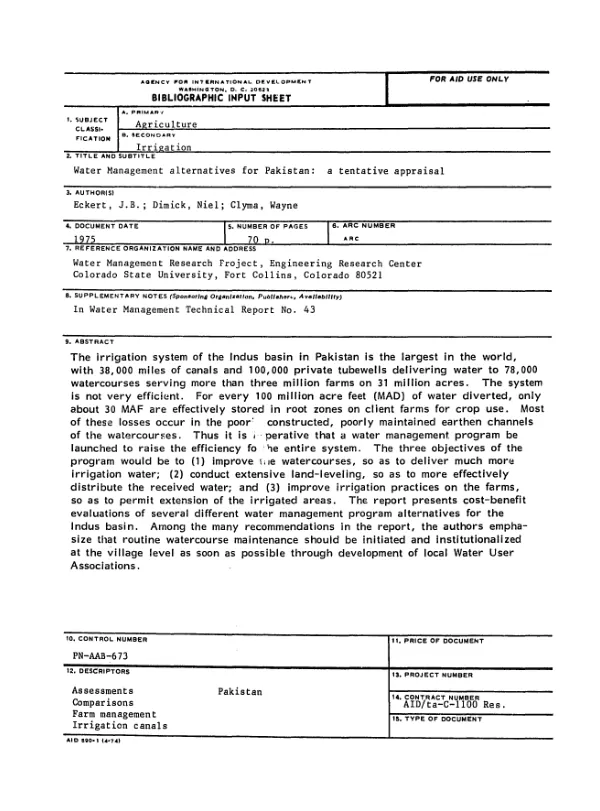
In Pakistan, some 80,000 watercourses serving over 30 million acres operate on a fixed rotation basis in which water is delivered for a fixed time to successive outlet points along the channel.
REUSS, JOHN O. · 1970
Sign in to readA free account is required to download.
Abstract
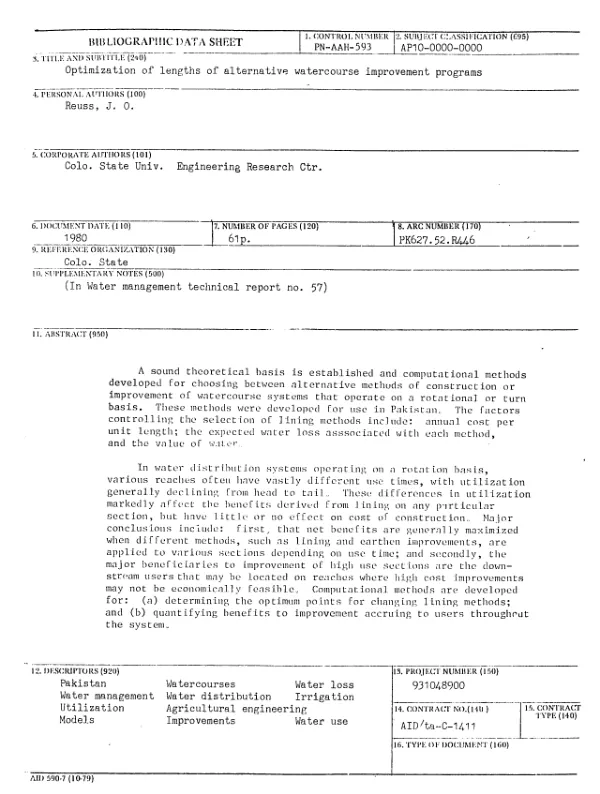
Heavy losses of water occur along these channels, and this has been identified as a major Pakistani development problem. This report puts forth a sound theoretical basis and develops computational methods for choosing between the alternative methods of construction or improvement of such watercourse systems. This task is made difficult by the fact that various sections of these systems will have vastly different use times, and these differences in utilization markedly affect the benefits derived from lining or other improvements on any particular section. After a brief introductory section, four theoretical considerations for evaluating alternatives (the linear loss assumption, nonlinear loss assumptions, the branched watercourse case, and distribution of benefits) are presented. The factors considered in the analyses as controlling the selection of an improvement or construction method include the annual cost per unit length, the expected water loss associated with each alternative, and the value of the water. Computational methods are developed for determining the optimum points for changing lining methods, and for quantifying benefits of improvement accruing to users throughout the system. The main body of the text concludes with discussion of these theoretical considerations and conclusions. The first major conclusion is that, depending on use time, net benefits are generally maximized when different construction methods, such as concrete lining and earthen improvements, are applied to various sections. Secondly, the major beneficiaries to improvement of high use sections are the downstream users that may be located on reaches where high cost improvements may not be economically feasible. A list of 66 Water Management Technical Reports available from Colorado State University and an eight-item biblioraphy of references specific to this report (1974-79) are also included.