EDUCATION DEVELOPMENT CENTER, INC. (EDC)
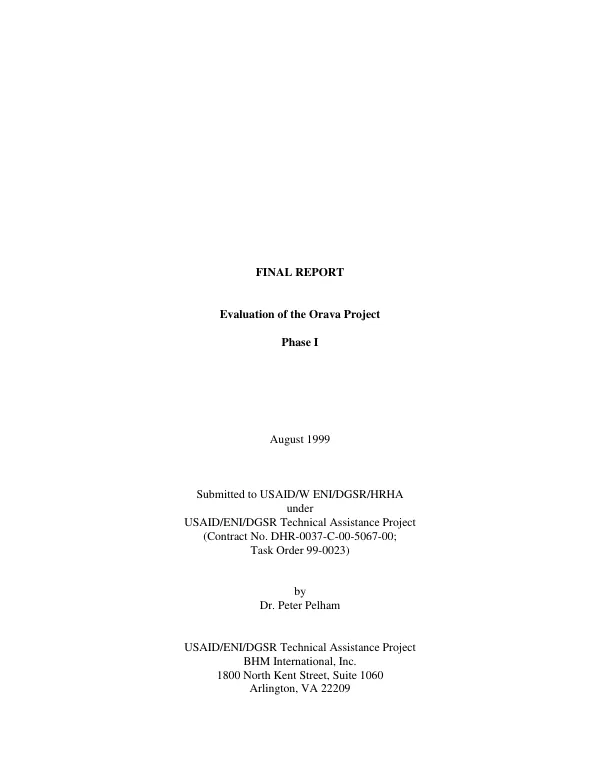
Orava project evaluation report : executive summary
Summarizes an interim evaluation (PD-ABS-787) of a project to infuse democratic concepts and procedures into the Slovak educational system, beginning in the central (Orava) region (Orava project).
Brady, Joanne P.; Spiro, Jody · 2000
Sign in to readA free account is required to download.
Abstract
The evaluation covered the period 1994- 1/00. The project is being implemented by University of Northern Iowa (UNI). Over the past 5 years, the Orava project has made a deep impact on the lives and work of participating Slovak teachers, school administrators, and university faculty. The continuity of its leadership has consistently provided a positive, guiding force for all project activities. The constancy of project leadership, combined with the internal integrity of the program design, has led to the development of a community of local educators committed to the values and practices inherent in democratic education. The project was initially designed to work simultaneously at the grassroots level and with the Ministry of Education (MOE). However, formal work with the Ministry and government institutions was not possible, given the difficult political climate of the recent past. Consequently, project energy was devoted to developing the grassroots approach. Specific conclusions of the evaluation are as follows: (1) The project has achieved its goal of infusing democratic concepts and procedures into the Slovak educational system. It has accomplished this by recruiting and developing a strong, enthusiastic cadre of educators (i.e., teachers, school leaders, administrators, and university faculty). (2) Project participants have demonstrated that they share a common set of values regarding democratic educational methods. It is also clear that they have begun to use these innovative methods frequently in their classroom practice. (3) Besides being taught to participants, democratic education has also been modeled for them. The co-project directors have used consensus building, negotiation, and collaborative methods in developing the programs and activities. This has served as a further model for participants in their own work in classroom teaching, teacher training, and education reform programs. (4) The project has made an impact on pre-service education of teachers. This is particularly evident in the adoption of innovative methods and programs by the pedagogical faculty at Comenius University. Specifically, the project has successfully developed and implemented the model program for the preparation of teachers and school leaders, which was one of its stated subgoals. (5) Since involvement in the Orava project is voluntary, alumni represent a cadre of self-selected people. This has been an excellent strategy for the program thus far. However, for the program to become truly sustainable, a supplemental strategy is needed to secure the participation of mainstream educators. (6) The current systems used to monitor program activity are ad hoc. As the program moves forward in its dissemination phase, a more cohesive system is needed to monitor and support the ongoing work of program alumni as they apply the Orava methods in their own classrooms and as they train "second generation" participants. (7) The Orava Association, the cooperating NGO, is in a critical transition year. Without the onsite involvement of the project"s co-directors who have returned to UNI, there is a need for organizational development (e.g., planning, staffing, staff training, and fundraising). There is also a need to continue to build institutional relationships with other agencies in order to ensure systematic dissemination and sustainability of the program. Includes recommendations to develop a plan for systematic dissemination of the project and to increase the management capacity of the Orava Association.