USAID DEC
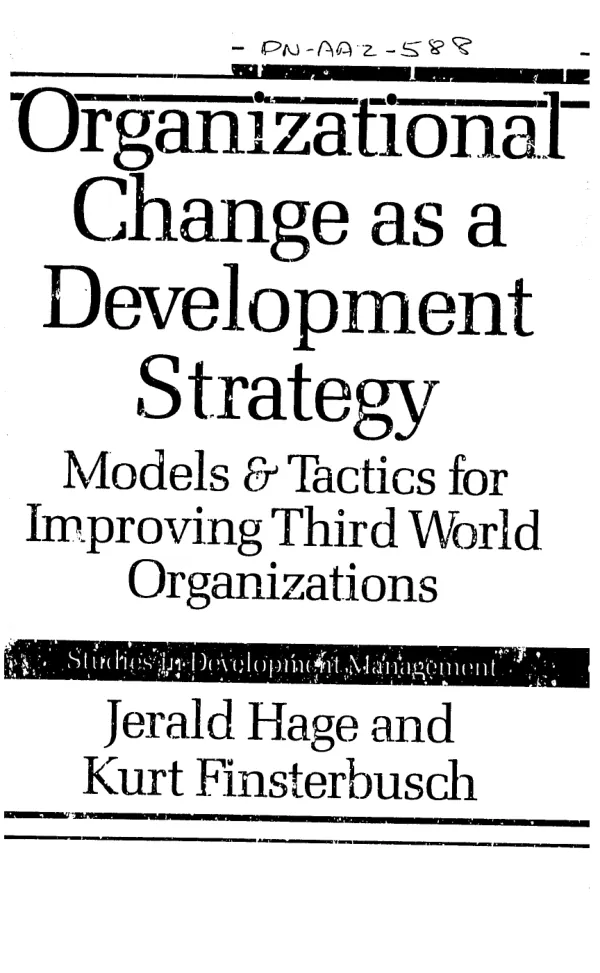
Organizational change as a development strategy : models and tactics for improving Third World organizations
Sign inNATIONAL ASSOCIATION OF SCHOOLS OF PUBLIC AFFAIRS AND ADMINISTRATION
Organizational change as a development strategy : models and tactics for improving Third World organizations
Are the organizational models of the West applicable to the Third World?
Hage, Jerald; Finsterbusch, Kurt · 1970
Sign in to readA free account is required to download.
Abstract
The authors of this volume answer with a qualified yes - if correct strategies for organizational change are employed. Chapter 1 examines the major strains of Western thought on organizational change, while Chapter 2 explains the contingency theory of organization, which holds that different situations (especially different levels of market demand and of technological sophistication) call for different organizational forms. Chapters 3 and 4 use contingency theory to examine twelve case studies from developing countries: six cases in which the purpose of a project was to change an organization, and six cases in which the purpose was to improve community services via organizational change. The major conclusions are: (1) at least six different organizational models - four of which were developed in Western organizational theory - can be effective in the Third World; and (2) many of the successful projects demonstrate the utility of contingency theory. Chapter 5, drawing on organizations from both the developed and developing worlds, suggests lessons for change agents. Provided in an epilogue are a comprehensive statement about the larger issue of how organizational change can best serve societal development, and a two-part strategy for bringing about such development.
Connected topics
Related documents
![Assess and strengthen the Jordan Tourism Board"s [JTB] institutional framework, management capacity and operations : developing and presenting the proposals for a revised organizational structure for JTB -- final report](https://covers.devme.ai/gen/40400.webp)