LOUIS BERGER INTERNATIONAL, INC. (LBII)
Other Modes and Related Industries
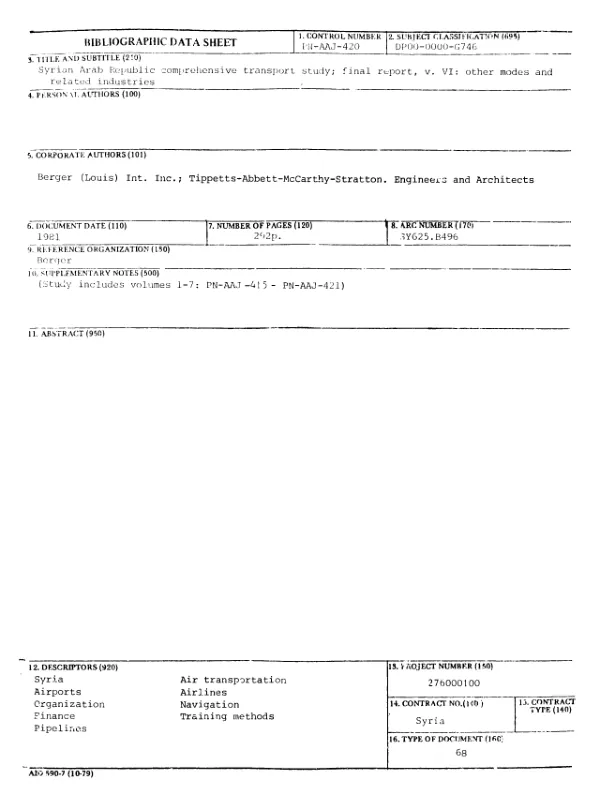
Syria"s efforts to meet its transport needs through the year 2000 are succeeding even in such disparate subsectors as aviation, pipelines, construction, and storage.
1970
Sign in to readA free account is required to download.
Abstract
So concludes this fifth of a seven-volume report on Syria"s transport sector. Syria easily meets current air travel demand with four domestic airports and an international airport at Damascus, with a second planned for Aleppo. The most urgent requirement in civil aviation is to revise the master plans of all these airports to eliminate obsolete or inefficient physical plants. Also needed are improved training programs for paraprofessional and lower-level personnel from Syrianair and the Directorate General for Civil Aviation. Syria should modernize its air navigation system by establishing a regional traffic control center in concert with its Arab neighbors and by straightening out flight routes wherever possible. Syrianair should also refurbish its fleet with 727"s and F-27"s for use on international and domestic routes, respectively. Three public corporations are responsible for Syria"s internal and external oil pipeline system and for domestic storage and marketing. All pipelines have ample capacity and maintenance is adequate. Feasibility studies should be conducted for pipelines between Homs, Al Raqqa, and Aleppo, and for new distribution centers at Damascus and Dera"a. Although Syria"s construction sector cannot be analyzed fully due to the government"s reluctance to provide vital industry statistics, available information indicates this sector will grow by an average of 7% per year from 1979 to 2000 and is capable of undertaking all building programs currently envisioned. Competitive bidding would make this sector healthier and more viable by equitably dividing contracts between the dominant public companies and private ones. Existing and planned storage capacity will be adequate, since present facilities can increase storage efficiency up to 100% by improving record-keeping systems needed for forecasting and by better managing present capacity.

![Championing economic growth best practices in Asia and the Middle East : Asia and Middle East economic growth and best practices project [final report]](https://covers.devme.ai/gen/97302.webp)