USAID DEC
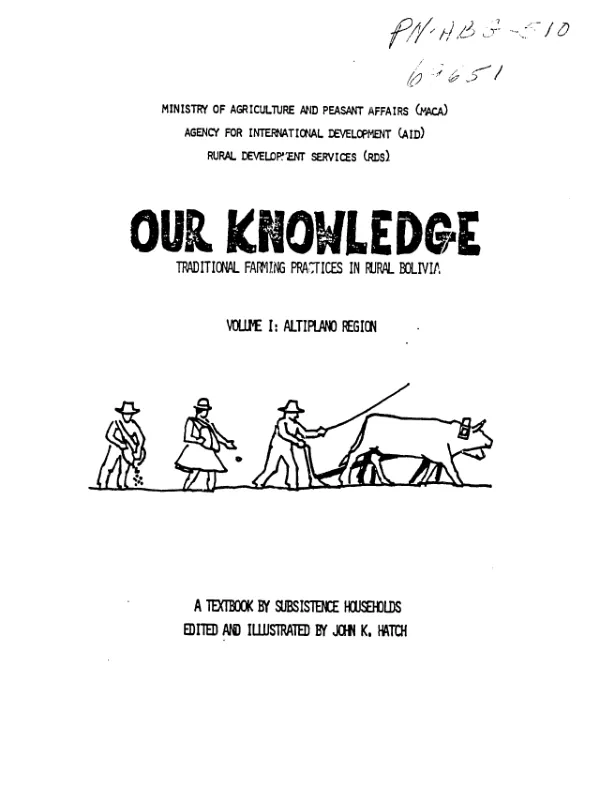
Our knowledge : traditional farming practices in rural Bolivia -- volume I, altiplano region
Sign inFOUNDATION FOR INTERNATIONAL COMMUNITY ASSISTANCE (FINCA)
Our knowledge : traditional farming practices in rural Bolivia -- volume I, altiplano region
This book, written by Bolivian peasants themselves, is an attempt to provide a comprehensive overview of subsistence farming practices and lifestyles in Bolivia"s altiplano region.
Hatch, John K., ed. · 1970
Sign in to readA free account is required to download.
Abstract
It covers: (1) general aspects of agricultural activities (e.g., tools, labor and irrigation arrangements, land tenure, marketing, climate, cropping patterns; (2) farming practices for specific crops (potatoes, barley. oca, habas, peas, maize, quinua, papalisa, onions); (3) livestock practices (cattle, burros, sheep, pigs, llamas, cobayos, livestock marketing); (4) food preparation (e.g., food preservation and equipment, typical diets, breakfasts and snack foods, soups, midday meals, suppers, emergency food, and making cheese, bread, and chicha; (5) hygiene and health (washing dishes, bathing, menstrual hygiene, childbirth, treatment of major diseases and minor ailments); (6) artisan crafts (weaving blankets, ponchos, and belts, making sweaters, different straws and their uses, braiding corn ears); and (7) holidays and celebrations (e.g., carnival, Easter, Christmas, marriage, burials, child"s first haircut, community bullfights, ceremonies to repel hail). Exactly 139 rural families from 13 communities participated actively in the study which produced the three-volume study of which this book forms a part. The contents are based on written narratives and diaries kept by these families over a 2-3 year period. Most of the co-authors are native Aymara or Quechua Indians; about one-third are illiterate (they were able to contribute by using school children or project staff as scribes and translators). Includes profiles of the co-authors.
![Peasant households in semi arid San Jose[, Bolivia] : confronting risk through diversification strategies](https://covers.devme.ai/gen/75088.webp)