JHPIEGO
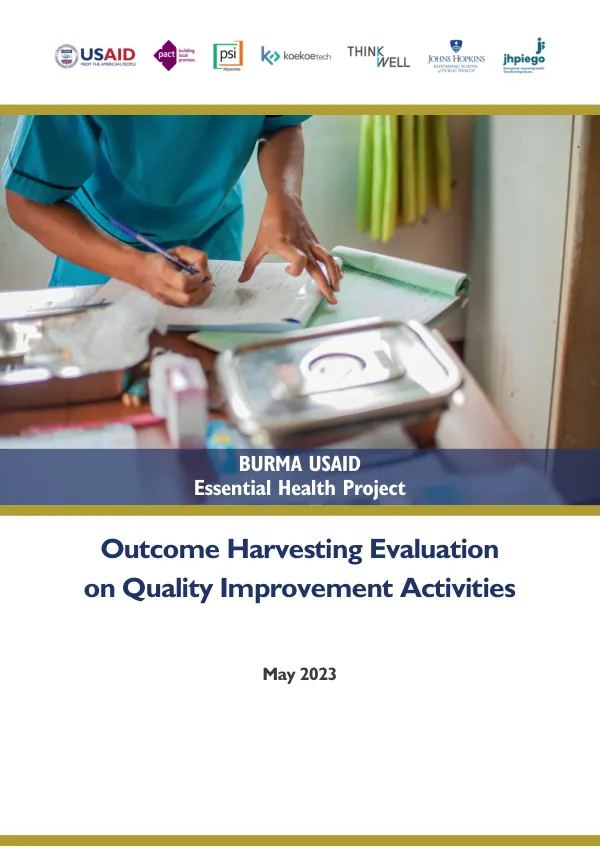
Outcome Harvesting Report
The Essential Health Project, a five-year initiative funded by the United States Agency for International Development (USAID), aimed to strengthen non-government and community organizations to support and sustain increased equitable access to essential health services.
2023 · 31 pages
Sign in to readA free account is required to download.
Abstract
The project's primary focus was to improve high-quality health service delivery among private, public, and non-governmental service providers in project townships. The project's objectives were to strengthen non-government and community organizations to support and sustain increased equitable access to essential health services, improve high-quality health service delivery among private, public, and non-governmental service providers in project townships, and increase effective demand for, access to, and utilization of quality essential health services. The Essential Health Project employed a qualitative approach known as Outcome Harvesting to assess the project's effectiveness. Outcome Harvesting is a methodology used to identify and document both anticipated and unanticipated outcomes resulting from project interventions. The evaluation aimed to examine how the project's activities under IR 2, which involve quality improvement efforts among private and NGO service providers, influenced the behaviors of various stakeholders. The evaluation team conducted a review of project documentation, including five annual reports, 21 quarter reports, 76 End-of-Week reports, and 30 success story reports. The team identified potential outcomes and drafted outcome descriptions to provide a clear understanding of the nature and significance of each outcome. The evaluation team also considered the involvement of other actors or factors that may have influenced the outcomes. The evaluation found significant improvements in the essential skills of service providers in MMCWA and MNMA maternity homes/clinics, driven by a series of Quality Improvement activities. The project contributed to improved quality in service sites of affiliated non-governmental maternity homes/clinics, GPs, and private hospitals through the use of the Surgical Safety Checklist. The evaluation also highlighted improved access to healthcare services through networking activities in private hospitals and demonstrated high client satisfaction with services provided by both GP clinics and maternity homes/clinics. The evaluation identified ten outcomes, with seven at the individual-level and three at the organizational-level, emphasizing the project's impact on improving the quality of healthcare services. The findings underscore the project's success in enhancing the skills and practices of service providers, improving the quality of healthcare services, and promoting client satisfaction. The evaluation team conducted external verification and substantiation of the outcomes, contacting several key individuals with relevant knowledge and insights to validate the findings. The evaluation aimed to provide actionable and usable information for primary users and stakeholders of the project. The Essential Health Project's initiatives have had a lasting impact on improving the quality of healthcare services in Burma. The project's success in enhancing the skills and practices of service providers, improving the quality of healthcare services, and promoting client satisfaction has provided valuable insights for decision-makers and implementing partners involved in the Essential Health Project.