ARTHUR D. LITTLE, INC.
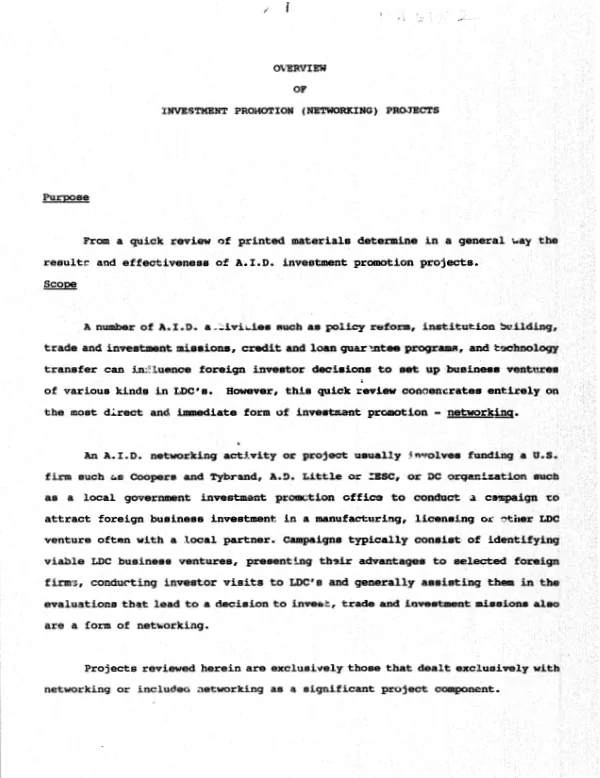
Overview of investment promotion (networking) projects
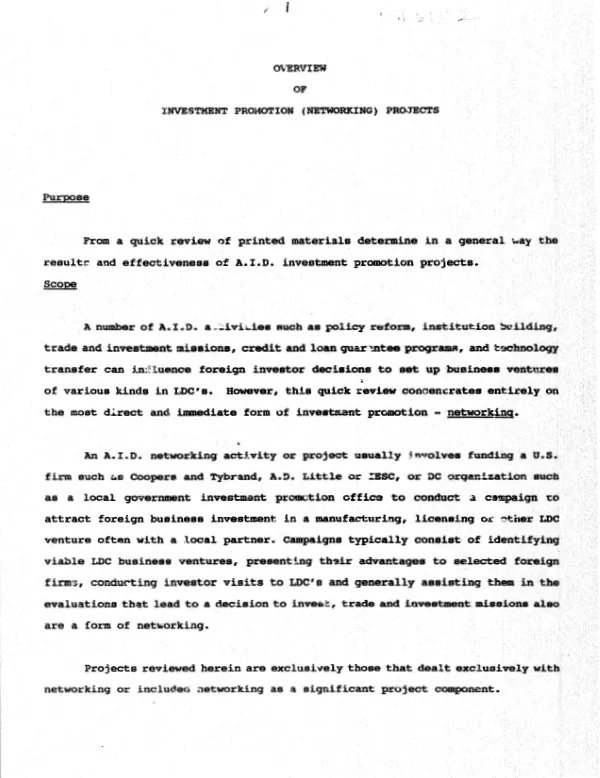
Presents an initial review of evaluations and other printed materials available in A.I.D./W on the networking components of A.I.D.'s investment promotion (IP) projects.
Sign in to readA free account is required to download.
Abstract
Such a networking activity usually involves funding of a U.S. firm or an LDC organization to conduct a campaign to attract foreign investment in an LDC business venture, often with a local partner. The review showed that A.I.D.'s IP projects have overwhelmingly returned very poor results in terms of levels of investment and business ventures and jobs created; they have also been very cost-ineffective. Only one project - Investment and Export Promotion in Costa Rica - was deemed successful, whereas 11 were rated as very poor or as failures; these included 4 projects in Latin America (Private Sector Productivity in Costa Rica, along with projects in El Salvador, Honduras, and the West Indies/Eastern Caribbean), 6 in Asia and the Near East (3 projects in Egypt and 1 each in Indonesia, Sri Lanka, and Thailand), and 1 in Africa. Data were lacking on projects in Belize, the Dominican Republic, Haiti, and Panama. The overriding and dominant factor dictating success or failure was found to be a good investment climate - something lacking in most developing countries. Other key factors include the need for: an accomplished business/marketing organization; an experienced, bilingual, mostly indigenous staff; a clear, well-planned, and well-executed IP plan; and an overseas promotional campaign. The review also showed IP to be a long-haul effort, with results likely to show up only after 1.5 to 2 years of hard work. It is recommended that A.I.D. support IP projects only in developing countries with a good investment climate; these countries include Thailand, Indonesia, India, and Costa Rica, followed by Guatemala, Ecuador, the Dominican Republic, and the Philippines. While countries such as Pakistan, Egypt, Jordan, Kenya, and the Ivory Coast will occasionally offer a viable investment opportunity, a multimillion dollar IP project in these countries is a waste of money. It is noted further that no developing country has enough viable potential business ventures to allow a promotion firm to make enough money from fees to cover costs. Nor are developing country governments likely to take up the funding of IP projects where A.I.D. leaves off. Other recommendations are to: (1) dedicate high cost networking IP projects solely to IP and have them operated by a private firm; (2) seek ways to cut costs; (3) and rigorously evaluate projects after 1.5-2 years and terminate those lacking promise.
Related documents