U.S. DEPT. OF COMMERCE. BUR. OF THE CENSUS (BUCEN). INTERNATIONAL STATISTICAL PROGRAMS CENTER
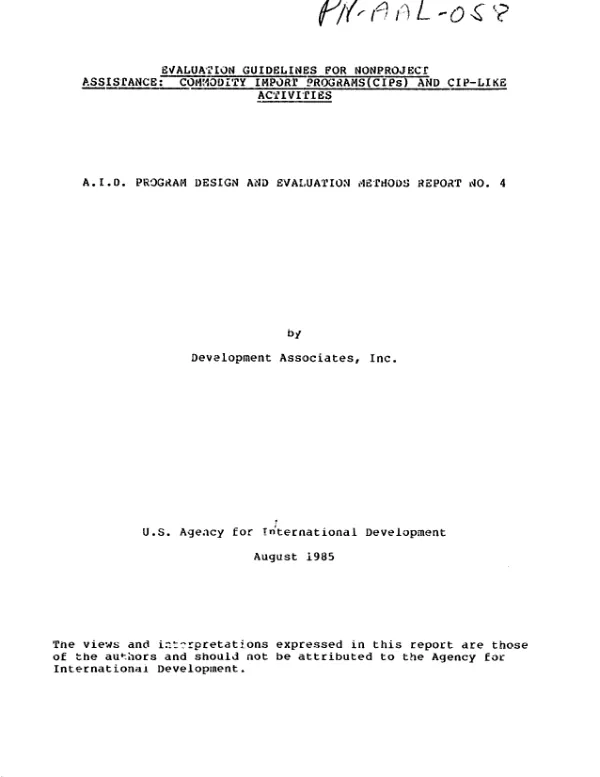
Overview of the evaluation of the Somalia CIP I (PAAD 649-0118)
Assesses a 4/84 special evaluation of the Commodity Import Program (CIP) in Somalia as a help in developing a methodology for CIP evaluations.
Ricardo, Jose M. · 1984
Sign in to readA free account is required to download.
Abstract
The evaluation focused (successfully) on only 3 issues - policy dialogue, use of local currency generations (LCG"s), and CIP allocation and implementation procedures; although all issues were adequately covered, the experience underlines the importance of structure, standard data sources, and methodological guidelines in CIP evaluations to ensure completeness, consistency, and reliability. It is suggested that CIP evaluations revolve around: (1) policy dialogue; (2) implementation and allocation efficiency; (3) compliance with project covenants; (4) developmental/economic impacts; and (5) use of LCG"s. Evaluators should be aware of unplanned and late developing issues not included in the evaluation plan (such as the overvalued official exchange rate in Somalia which enabled importers to reap windfall profits). The approach must be qualitative, as CIP objectives are not all quantifiable; inclusion of a logframe in the design document for each of these objectives would help evaluators define indicators of project success. The Somalia CIP proves the difficulty of evaluating activities benefiting an entire population; by the project"s nature, rigorous testing was impossible. Macroeconomic analysis was obscured by lack of current and reliable trade and production data and the economy"s vulnerability to external events, making it difficult to isolate CIP effects on balance of payments (BOP). Direct measures of CIP micro effects are possible but face a dearth of baseline data. Other findings generally relevant to most CIP programs are, inter alia: CIP audits should be consulted for possible evaluation issues; LCG"s from CIP"s are a real development resource (and in Somalia"s case were subject to effective monitoring procedures); efficiency criteria for CIP allocations are needed; the CIP donor may reap export promotion benefits in trade fostered by the program; CIP"s offer an opportunity to reorient host country policies (e.g., towards free market procedures); CIP"s can revitalize the private sector - in Somalia, 69% of CIP imports were allocated to the private sector, vs. 16% planned. Attached are a CIP evaluation procedural guide and a list of suggested indicators.
Related documents