USAID DEC
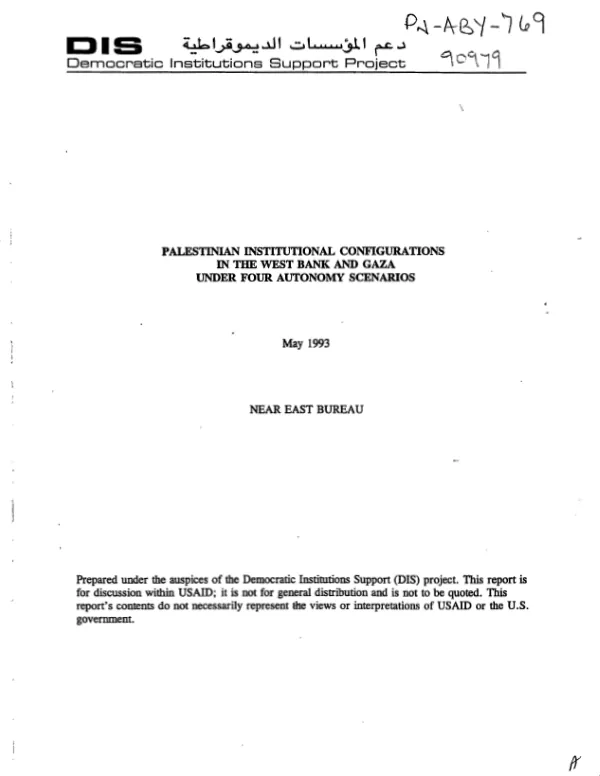
Palestinian institutional configurations in the West Bank and Gaza under four autonomy scenarios
Sign inCHEMONICS INTERNATIONAL, INC.
Palestinian institutional configurations in the West Bank and Gaza under four autonomy scenarios
This essay outlines the major Palestinian institutional clusters in the West Bank and Gaza Strip, and suggests the potential impacts of four different autonomy scenarios on these institutions.
Robinson, Glenn · 1993
Sign in to readA free account is required to download.
Abstract
Most major Palestinian institutions, especially in the health, agricultural, and industrial sectors, are affiliated with one of the principal factions of the Palestine Liberation Organization (Fatah, PFLP, PPP, and the two wings of the DFLP). The single most important fact affecting the future of Palestinian institutional development in the occupied territories is that Fatah, through its recent creation of Higher Councils in virtually all sectors, is seeking to monopolize and control all major development sectors in the West Bank and Gaza in preparation for autonomy. Its success in preparing itself to control development aid has created a dilemma for factions opposing the current negotiations, primarily the PFLP and DFLP(H), both of which have built a relatively sophisticated network of grassroots institutions in the West Bank and Gaza. By remaining opposed to the negotiations, these factions remain true to their constituencies, but risk losing substantial funding for their projects. If they reversed their opposition, funding would likely increase, but they would alienate their supporters and run the risk of falling under Fatah hegemony. The four autonomy scenarios examined in the essay vary with respect to the speed of implementing autonomy and its extent. Each of the scenarios would create a different pattern of political and institutional winners and losers. (1) Institutional Monopoly: a full autonomy slowly implemented would enable Fatah to consolidate its position; non-Fatah grassroots institutions would be slowly starved of resources. (2) Institutional Pluralism: rapid implementation of full autonomy would preserve institutional pluralism by freezing the institutional balance between political factions, and between centralized and grassroots authority. (3) Institutional Paralysis: a limited autonomy rapidly implemented would create a stalemate between Fatah and non-Fatah institutions. Fatah would seek a coalition with Jordan. Civil war is possible. (4) Millet Model: a limited autonomy slowly implemented would reflect an Israeli-Jordanian condominium over the occupied territories. Palestinians would be offered limited municipal authority. Intifada would continue. (Author abstract, modified)
Related documents