USAID. BUR. FOR POLICY AND PROGRAM COORDINATION. CENTER FOR DEVELOPMENT INFORMATION AND EVALUATION (CDIE)
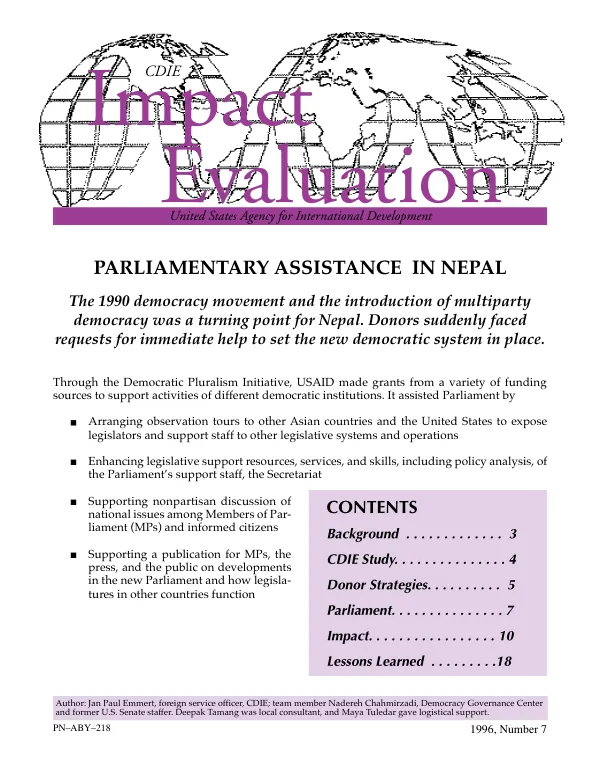
Parliamentary assistance in Nepal
In 1990 Nepal was swept by a democratic revolution that established a new constitution and multiparty democracy, limited, the king's power, recognized the people as sovereign, set up a directly elected parliament, brought the major parties out from underground, and guaranteed human rights.
Emmert, Jan Paul · 1995
Sign in to readA free account is required to download.
Abstract
The United States and other donors attempted to give international recognition to this change and to sustain the democratic opening. This evaluation examines the assistance provided in the legislative arena, assesses its impact, and draws lessons for legislative assistance in other countries. USAID's primary objective was to help Nepal establish the new parliament as a functioning democratic institution, its main strategies to support observation tours to Asian countries and the United States to expose staff and Members of Parliament (MPs) to legislatures in other countries, developing Secretariat support services, fostering nonpartisan discussion among MPs and citizen groups on national issues, and informing MPs and citizens about parliamentary developments in Nepal and abroad. Specific USAID grants supported (1) an orientation program for new MPs, (2) intermittent visits by an Asia Foundation consultant to develop a needs assessment and long-range development plan, (3) an internship program for recent university graduates, (4) assistance to the parliamentary library, (5) a modest computer capacity, and (6) support of a NGO that held seminars and produced a monthly publication about parliament. At a broad level, the goals of the Nepal government and donors have been achieved. Parliament is functioning and at the center of political life. Multiparty democracy is becoming institutionalized, and few seek to undo the democratic changes. Peaceful transitions of government have occurred, with opposing parties acceding to controversial Supreme Court decisions. Although the credit for these accomplishments goes to Nepalis, donor assistance has had four important identifiable impacts. (1) As a result of observation tours, Nepal adopted a committee system that is already helping Parliament function more effectively. (2) A surprisingly strong and popular oversight role has developed in the Public Accounts Committee, injecting a degree of accountability previously unknown in government agencies. (3) The Secretariat has gained a sense of professionalism. Computerization has greatly increased efficiency in tracking bills, maintaining current versions of bills, and producing documents needed by parliament to be effective and transparent. The experience in Nepal provides a rich case for lessons about assistance to parliamentary systems, useful low-cost interventions, interagency cooperation, external actors in the legislative arena, and managing legislative assistance. (Author abstract, modified)
Related documents