USAID. MISSION TO HAITI
Participant training evaluation
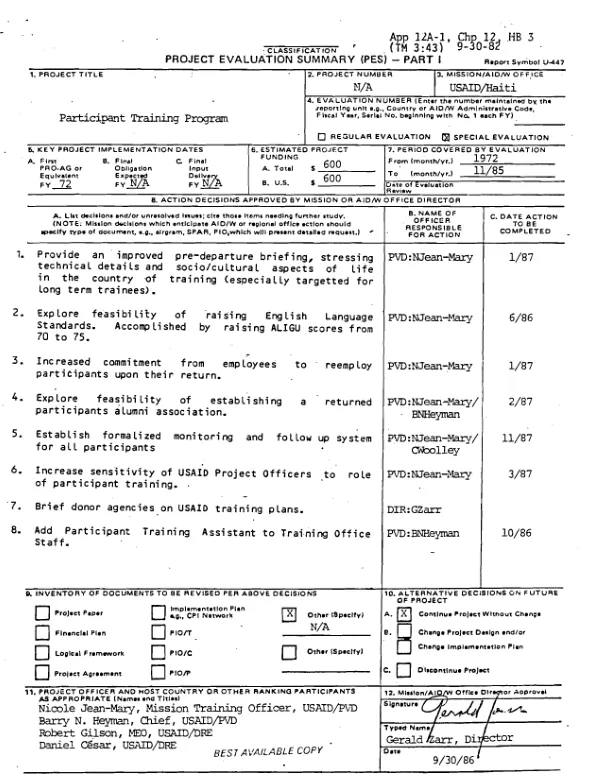
Evaluates A.I.D.'s participant training program in Haiti.
Elmer, Laurel|Tardieu-Dehoux, Charles · 1985
Sign in to readA free account is required to download.
Abstract
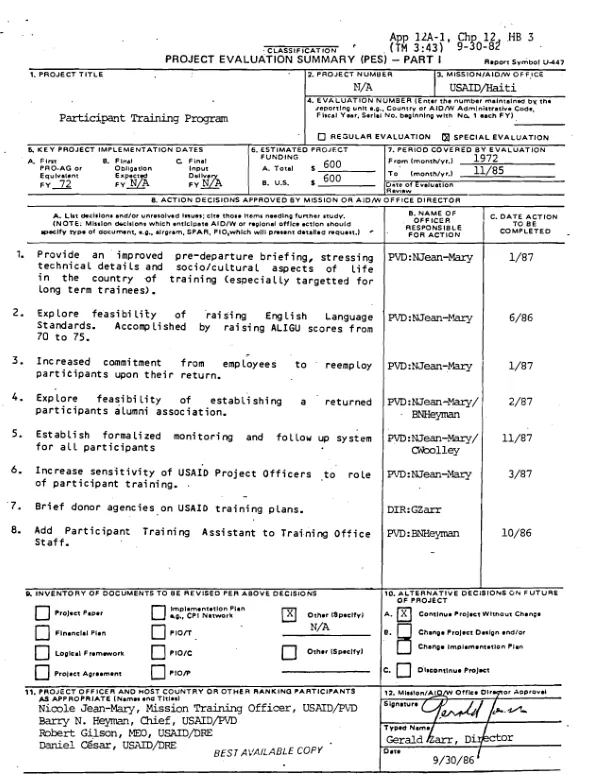
External evaluation covers the period 1972-11/86 and is based on 200 questionnaire responses from and 62 interviews with returned participants (from a universe of 288 of the 395 participants trained) and interviews with Haitian and USAID/H officials. Most A.I.D. participants are sponsored by government ministries, typically for short-term (ST) U.S. training in health, management, and agriculture. The smaller percentage of centrally funded training includes standard programs in management and health and regional scholarship programs. Most participants are male, but the number of females has increased in recent years. Intra-USAID/H communication regarding training opportunities is weak and coordination with other donor programs poor. Problems have been encountered in finding qualified candidates. Participants have generally not been involved in the selection process or in planning their programs - long-term (LT) and private sector participants have been more so. Most participants have been well informed of administrative details, but less well briefed on technical matters and on the culture of the country of training (less than half of U.S. trainees and a single third-country trainee received orientation upon arrival). Still, the majority received adequate administrative support and experienced no serious problems, although a number of housing problems were reported, especially by females, and several trainees stated that they would have benefited from better English skills. Most participants are highly satisfied with the quality, relevance, and level of their training. Satisfaction varies according to field, with management trainees reporting the greatest and engineering trainees the least. In addition to the benefit of specialized knowlege, participants reported significant changes in their professional attitude; supervisors have noted their increased discipline and motivation. Most LT and a surprising number of ST participants had no job upon their return. Nevertheless, most are in a training-related job, and despite poor working conditions and limited administrative support, almost half claim to be successfully introducing new ideas and changes in their jobs. Many have received advancements and increased responsibility due to training (women reported proportionately fewer such increases than did males); LT training appears to have had a greater impact on promotion than has ST. Establishment of professional and social contacts has been a program benefit; many participants are corresponding with their training institution or a professional contact made during the program. Almost all welcomed the idea of an alumni association.
Related documents