USAID. DIRECTORATE FOR POLICY. CENTER FOR DEVELOPMENT INFORMATION AND EVALUATION (CDIE). OFC. OF EVALUATION
Performance-based budgeting system for the Agency for International Development
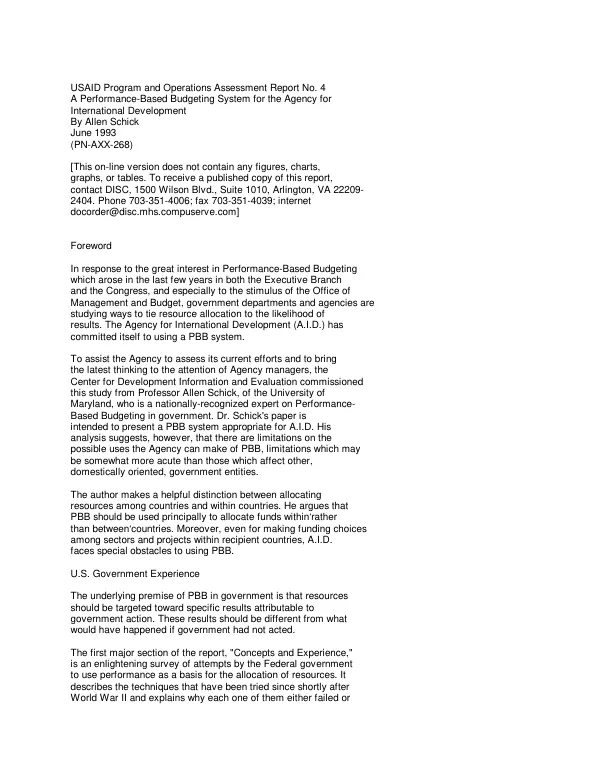
In response to the great interest in performance-based budgeting (PBB) which has arisen in the past few years, U.S.
Schick, Allen · 1993
Sign in to readA free account is required to download.
Abstract
government departments and agencies are studying ways to tie resource allocation to the likelihood of results. A.I.D. has committed itself to using a PBB system. This study, commissioned to define a PBB system appropriate for A.I.D., suggests there are limitations on the uses the Agency can make of PBB, limitations which may be somewhat more acute that those that affect domestically oriented U.S. agencies. The author makes a distinction between allocating resources among countries and within countries, arguing that PBB should be used principally to allocate funds within countries. However, even for making funding choices among sectors and projects within a country, A.I.D. faces special obstacles to using PBB. The first major section of the report surveys attempts by the Federal government to use performance as a basis for the allocation of resources. It describes techniques that have been tried since shortly after World War II and explains why each of them either failed or was abandoned. Their failure to thrive is probably explained by the fact that too many factors other than performance actually affect budget decisions. The next section reviews A.I.D."s efforts over 30 years to find a rational approach to allocating resources, including the recently adopted Program Performance Information System for Strategic Management (PRISM). The author points out that A.I.D."s version of PBB does not meet accepted definitions because it is based on the policy and economic conditions in the country to be assisted. In Section three the author defines the conditions under which performance might be used to create an effective resource allocation system for A.I.D., makes specific recommendations, and explains the many reforms of the practices of both A.I.D. and Congress that will be needed. This section lays out a blueprint for a new relationship between A.I.D. and Congress, with Congress giving up its current micromanagement. Many internal changes are required of A.I.D. as well, including steps to provide clear management leadership and policy guidance; consolidate small, low-impact projects into fewer activities with significant impacts on development; and deobligate troubled projects and enforce realistic timetables.
Related documents
![The U.S. interest in international development : a basis for building long-term collaborative relationships with developing countries [summary]](https://covers.devme.ai/gen/29720.webp)