INTERNEWS
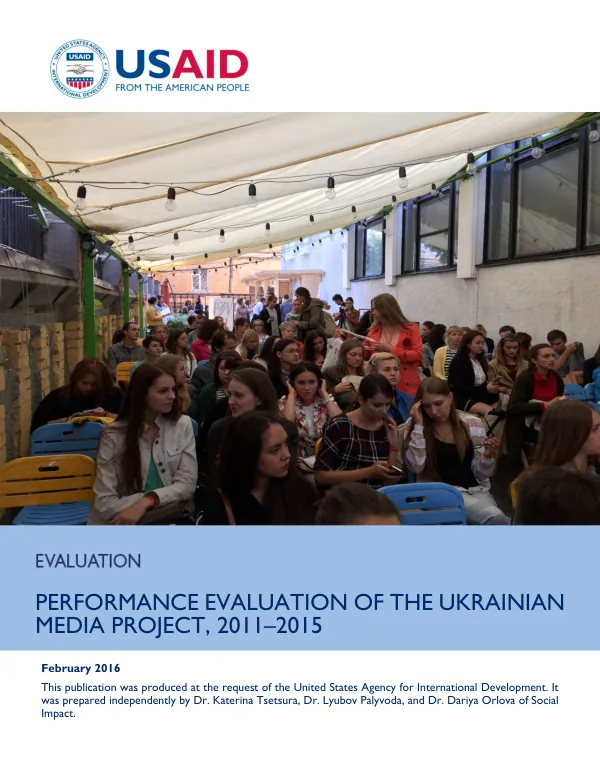
Performance Evaluation of the Ukraine Media Project, 2011–2015
The Ukraine Media Project, implemented by Internews, aimed to promote media independence and quality of news in Ukraine from 2011 to 2015.
2016 · 174 pages
Sign in to readA free account is required to download.
Abstract
The project had four objectives, with varying degrees of priority, including supporting freedom of speech and media independence, increasing the variety of news sources and improving news quality, improving the enabling environment for media and freedom of speech, and improving organizational capacity of Ukrainian media civil society organizations. The project provided grants to three types of beneficiaries, including institutional partners, core partners, and emerging and short-term partners, to achieve these objectives. The project's budget was $14 million, which increased to $15.85 million, with at least 55% allocated to fund local Ukrainian media organizations. The evaluation of the project was conducted to assess the relevance and effectiveness of selected U-Media activities, with a focus on objectives I and II, and to inform potential follow-on programming. The evaluation was conducted through a desk review of U-Media documentation, in-depth semi-structured interviews, case studies, and an online mini-survey. The evaluation aimed to answer six questions, including the advantages and disadvantages of working with U-Media for various stakeholders, how Internews tailored its tools and approaches to satisfy the diverse needs of its partners, and which tools and approaches were perceived as the most useful for influencing media context and media content. The project's activities included providing grants to local Ukrainian media organizations, promoting media independence and quality of news, and improving the enabling environment for media and freedom of speech. The project's stakeholders included U-Media grantees and partners, non-assisted civil society organizations, private-sector organizations, governmental organizations, and other donors. The evaluation found that the project had a positive impact on the media context and media content in Ukraine, with stakeholders perceiving major changes in the media context and media content as a result of the project's work. The evaluation also identified best practices and behaviors promoted by the project, which were adopted and actively used by partner organizations to influence media context and media content. The evaluation recommended that future programming should focus on building on the project's successes, including promoting media independence and quality of news, and improving the enabling environment for media and freedom of speech. The evaluation also suggested that future programming should prioritize the needs of local Ukrainian media organizations and civil society organizations. The project's geographic focus was Ukraine, with a specific emphasis on promoting media independence and quality of news in the country. The project's timeframes were from 2011 to 2015, with a focus on achieving the project's objectives during this period. The project's methodology included a desk review of U-Media documentation, in-depth semi-structured interviews, case studies, and an online mini-survey. The evaluation aimed to assess the relevance and effectiveness of selected U-Media activities, with a focus on objectives I and II, and to inform potential follow-on programming. The project's recommendations for future programming included building on the project's successes, prioritizing the needs of local Ukrainian media organizations and civil society organizations, and focusing on promoting media independence and quality of news.