MANAGEMENT SYSTEMS INTERNATIONAL, INC. (MSI)
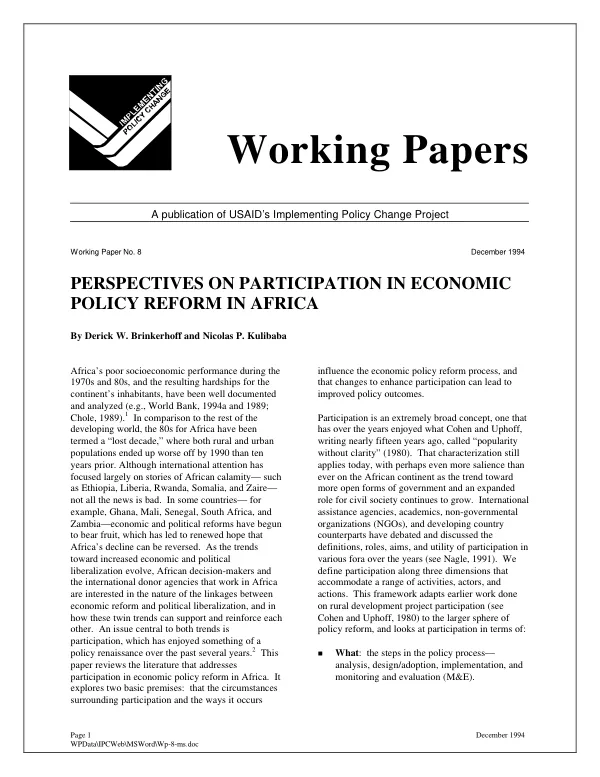
Perspectives on participation in economic policy reform in Africa
As economic and political liberalization continue to evolve in Africa, African decisionmakers and international donor agencies have become interested in how the two trends may support and reinforce each other.
Brinkerhoff, Derick W.; Kulibaba, Nicolas P. · 1994
Sign in to readA free account is required to download.
Abstract
An issue central to both trends, popular participation, has enjoyed something of a policy renaissance over the past several years. This paper reviews the literature on participation in economic reform, and specifically examines whether patterns of participation influence the reform process. The authors find that the circumstances surrounding participation and the way in which it occurs do affect the economic reform process, but these effects can be complex and are closely intertwined with political and governance factors. For the most part, chances for participation are better under democratic than authoritarian regimes, and in societies which are rich in social capital and associational life. Increased participation appears to enhance prospects for sustainable as well as technically sound policy reforms, but creating opportunities for participation and managing the process over time are exacting tasks for reformers. The report advises collaborative policy design; improving the institutional capacities of NGOs, private sector groups, political parties, and the media; increasing opportunities for participation through matching grants, revenue-sharing mechanisms, and the participation of research centers and local NGOs in data collection on policy impacts; and greater openness to mid-course corrections in policy implementation. Issues in Africa"s swiftly changing sociopolitical and economic dynamics demanding further attention are identified in conclusion. Includes an extensive bibliography.