HUDSON INSTITUTE
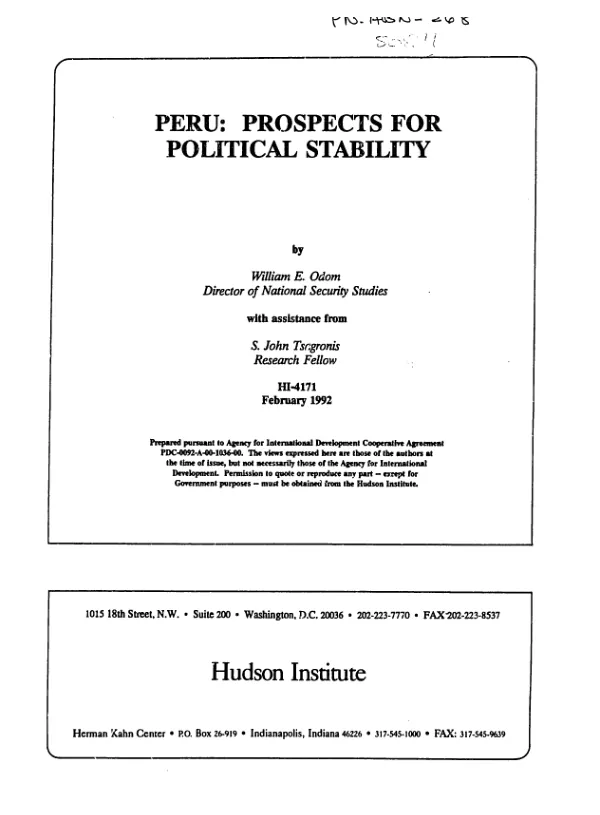
Peru : prospects for political stability
This paper assesses Peru"s prospects for political stability in light of the analytic framework proposed in the Hudson Institute"s "On Internal War: American and Soviet Approaches to Third World Clients and Insurgencies," namely, that any political entity (whether an incumbent government or an insurgency) must be able to create a new political stability to ensure its success following its rise to power.
Odom, William E.; Tsagronis, S. John · 1992
Sign in to readA free account is required to download.
Abstract
The study is in four parts. Part 1 presents a short survey of Peru"s political development from the colonial period to the present, while Part 2 assesses the economic, sociopolitical, external, and cultural factors that constitute the pre-conditions for democracy in Peru. Part 3 analyzes the respective political strategies of Peruvian insurgents (especially the Shining Path) and of the government; extensive discussion is given to the government"s record in attaining political development goals. Part 4 examines the political, economic, and military implications for U.S. strategy.
Connected topics