USAID. MISSION TO HONDURAS
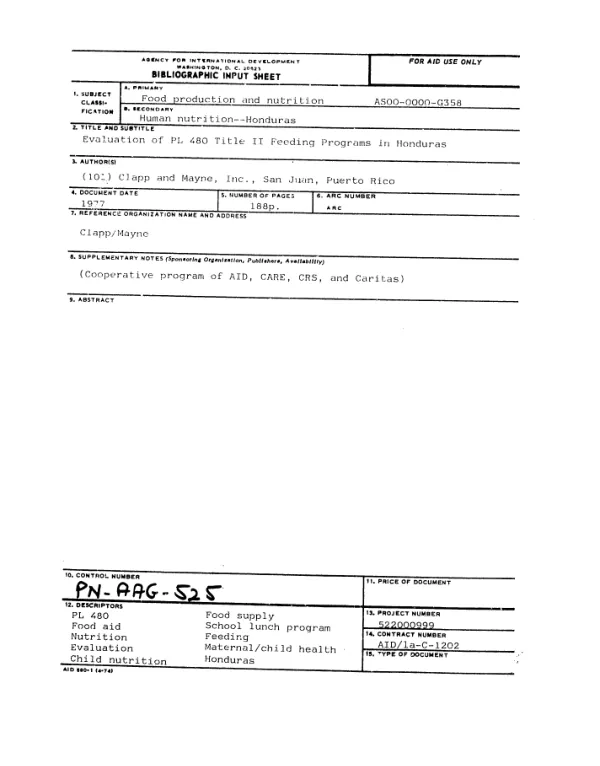
PL-480 Title II program
Summarizes external evaluation (PD-AAW-648) of P.L.
Szepesy, E.; Park, Thomas E. +1 more · 1987
Sign in to readA free account is required to download.
Abstract
480 Title II maternal/child health (MCH) and school feeding (SF) programs implemented by CARE in Honduras. Evaluation covered the period through Spring 1987 and was based on surveys of beneficiaries and control groups. Findings were inconclusive. Under the SF program, math and social science grades were positively affected by consumption of the P.L. 480 beverage, but science and Spanish grades were not. Consumption of the beverage was not found to be directly related to either school attendance or nutritional status. Children most in need of the supplement were drinking it. Under the MCH program, P.L. 480 food, whether consumed at a feeding center or consumed at home and shared with the entire family, improved women"s childbearing and children"s growth. Evaluation findings point to the following lessons. (1) Targeting strategies and the provision of complementary inputs (including training for teachers and school supervisors) should be tailored to selected areas. (2) Future evaluations should have a more realistic time frame than the four weeks allotted for this study. (3) The most serious problems in program delivery occur within community organizations, where targeting is minimal and surveillance lacking. (4) Program overlap between community centers and the National Social Welfare Board (JNBS) contributes to delivery problems.(5) Without growth monitoring it is very difficult to assess the program"s nutritional impact. Action decisions are for CARE and the Ministry of Education to begin a longitudinal study to measure the educational impact of the SF program and for USAID/H to encourage JNBS to integrate growth surveillance systems into all of its MCH programs. For further detail on the evaluation findings, see abstract of PD-AAW-860. (Author abstract, modified)
Related documents