ACADEMY FOR EDUCATIONAL DEVELOPMENT, INC. (AED)
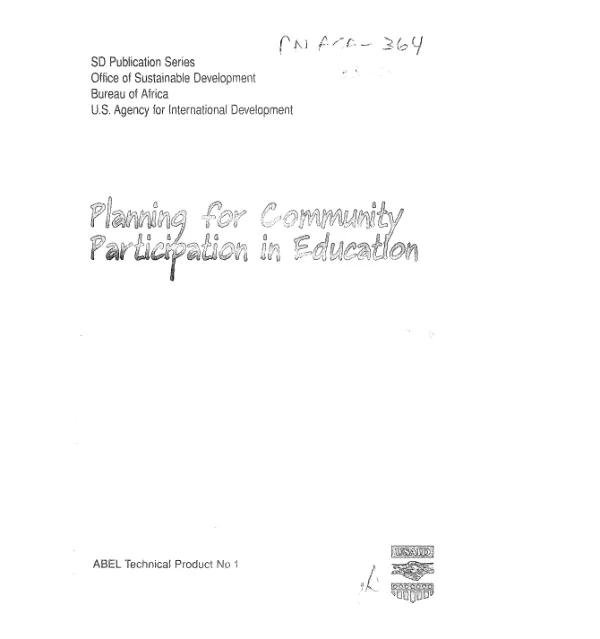
Planning for community participation in education
Educational projects that draw upon community involvement have a number of strengths, such as improved effectiveness and efficiency, increased self-reliance and community empowerment, extended coverage, and sustainability.
Wolf, Joyce; Kane, Eileen +1 more · 1997
Sign in to readA free account is required to download.
Abstract
This computer software program and its accompanying manual are intended to help practitioners get a better understanding of how communities can become active partners in education. The first section of the program discusses what community participation consists of, what facilitates it, what obstructs it, and what its benefits are. The program presents the user with four main headings (goals, strategies, context, and case studies), each of which, when clicked, takes the user to a series of subtopics, most of which are illustrated with a case study. The educational goals the user may select from include: improved quality for increased learning; improved equitable access and retention; increased school relevance and attractiveness to children and parents; and increased decision making role of community members. Context headings include: decentralization of the educational system; basis of school financial support; cultural factors; government practices and policies; demographic factors; and school and institutional structures. Strategies that are discussed and illustrated include: improving teachers; improving schools; improving curriculum; information and institutional linkages; and improved community infrastructure and technologies. The case studies give examples of what schools and communities have accomplished together in almost every area of education. To run the program, the user will need an IBM-compatible 386 or better computer, 8 MB of RAM, 8 MB of free hard drive space, and Windows 3.1, Windows 95, or Windows NT 3.51/4.0. Includes bibliography.
Related documents


![Project management manual for ABET [adult basic education and training] practitioners](https://covers.devme.ai/gen/18771.webp)
![Qualification and assessment system for ABET [adult basic education and training] with action plan](https://covers.devme.ai/gen/26905.webp)
![Using consultative research to adapt the IMCI [integrated management of childhood illnesses] feeding recommendations to a local context : training guide](https://covers.devme.ai/gen/48004.webp)