USAID DEC
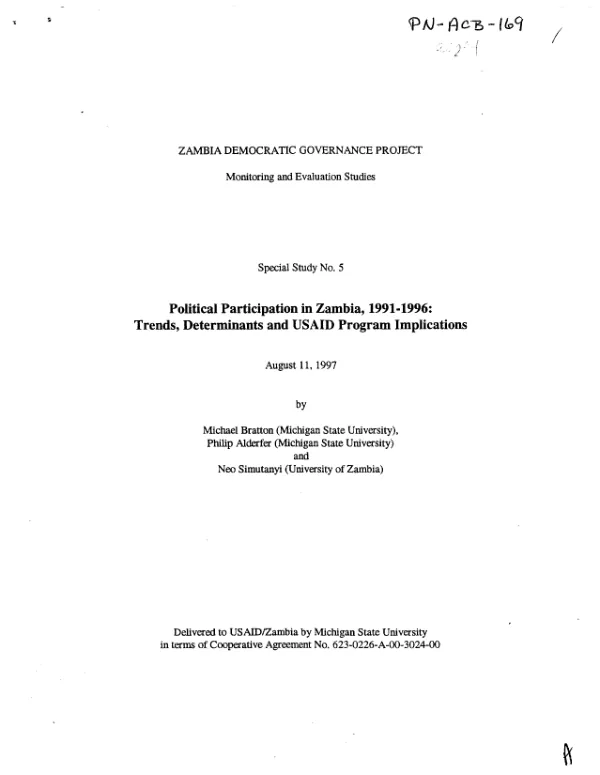
Political participation in Zambia, 1991-1996 : trends, determinants and USAID program implications
Sign inMICHIGAN STATE UNIVERSITY
Political participation in Zambia, 1991-1996 : trends, determinants and USAID program implications
This study, based on a comparison of surveys conducted in 6/93 and 11/96, examines trends in popular political participation from the time of Zambia"s democratic transition in 1991 through the country"s 1996 general elections, and draws implications for the Mission"s Democratic Governance Project.
Bratton, Michael; Alderfer, Philip +1 more · 1997
Sign in to readA free account is required to download.
Abstract
An overwhelming majority of Zambians endorsed the integrity of the 1996 elections, though they were flawed by the actions of the Chiluba government and met with international and domestic condemnation, focusing on the Movement for Multiparty Democracy"s (MMD) manipulation of constitutional rules. While problems with voter registration resulted in fewer eligible adults at the polls in 1996, the proportion of registered voters claiming to have voted increased significantly, though fewer Zambians reported attending an election rally or working for a political party. Zambians continued to report high levels of involvement in community meetings and collective action, and to rely heavily on local notables and church organizations, rather than on governmental agencies, in solving problems of socioeconomic development. Yet Zambians were almost twice as likely to have lobbied a Member of Parliament (MP), rather than traditional leaders, for help, despite a sharp dropoff in satisfaction with MPs" ability to deliver development benefits. Not only did Zambians" grasp of the country"s new democratic regime improve notably, but they have remained strongly in favor of political reform. The majority of Zambians said that the 1991 transition was good for the country and preferred multiparty competition to one-party rule and elected to effective government. Two political institutions constituted gateways to active citizenship: voter registration and political party membership. Voter registration, the opportunities for which are not widely distributed, led not only to voting but also to attendance at community meetings, and to contacting political leaders. Card-carrying members of political parties were more likely to vote and otherwise participate politically. Unfortunately, the original weaknesses of parties and the limited numbers of party members has prevented more widespread political participation in Zambia. Finally, membership in voluntary associations did not promote participation in 1996, though it had earlier. It seems that, having attained their goal of political change, and facing the need to attend to pressing issues of economic survival, Zambians pulled back from what had been an intense period of involvement in associational life. Recommendations for USAID/Zambia are offered in conclusion. Includes references. (Author abstract, modified)