USAID DEC
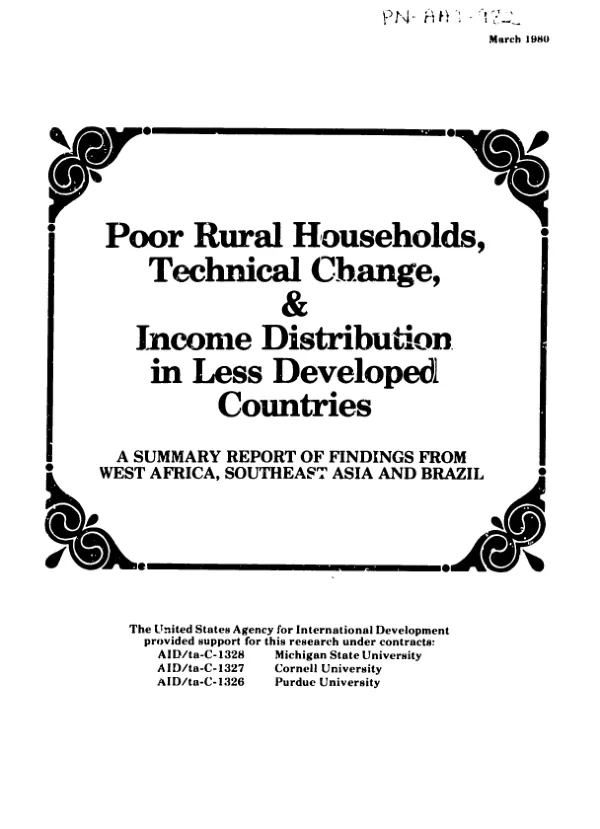
Poor rural households, technical change, & income distribution in less developed countries : a summary report of findings from West Africa, Southeast Asia, and Brazil
Sign inCORNELL UNIVERSITY. NEW YORK STATE COLLEGE OF AGRICULTURE AND LIFE SCIENCES
Poor rural households, technical change, & income distribution in less developed countries : a summary report of findings from West Africa, Southeast Asia, and Brazil
To help solve the riddle of why many developing country farmers continue to live in abject poverty while new farm technology is steadily increasing aggregate farm output, this report summarizes and compares studies conducted in selected sites in West Africa, Southeast Asia, and Brazil on the use of new farm technology and its impact on the rural poor.
1970
Sign in to readA free account is required to download.
Abstract
The basic results of the three studies are as follows: (1) Income increases in West Africa have been modest due to removal of subsidies for technical improvements, but were substantial in the Philippines, although mechanical threshers directly displaced the labor of the landless and near-landless. Brazil showed a potential for increased income given adequate credit and extension. (2) High short-term input costs, perceived risks of change, inadequate extension services, and product price inelasticity all significantly constrained adoption of modern technology by small farmers. In Southeast Asia, there was a sharp contrast between what was feasible experimentally and what was commercially profitable. (3) As to resource use efficiency, land and fertilizer were significantly underused in Africa due to societal land use restrictions which placed land costs below production value. Small farmers in Asia generally used labor more efficiently than did large farmers and practiced intercropping widely, although they rarely achieved optimum crop combinations. In Brazil, both landowners and tenants underused capital, but owners tended more to lack labor and tenants land. (4) Because educated workers dominated rural-urban flows and were more successful than the noneducated in finding urban jobs, income disparities between rural and urban areas tended to widen in all areas studied. Brazil was the most efficient in allocating labor both within and among sectors. (5) Poor farm women worked to supplement subsistence farm income, in Africa and Asia taking on menial jobs to free men for higher paying but less secure jobs. (6) Most household expenditures of the poor are for food. In Africa, the poor consume more than they can grow, so that grain price increases will worsen income inequality. In Northeast Brazil, consumption expenditures declined as income rose. Bibliographies totaling 112 references in Spanish and English (1957-79) are included.
Related documents