USAID. MISSION TO MOROCCO
Population and family planning support project phase III
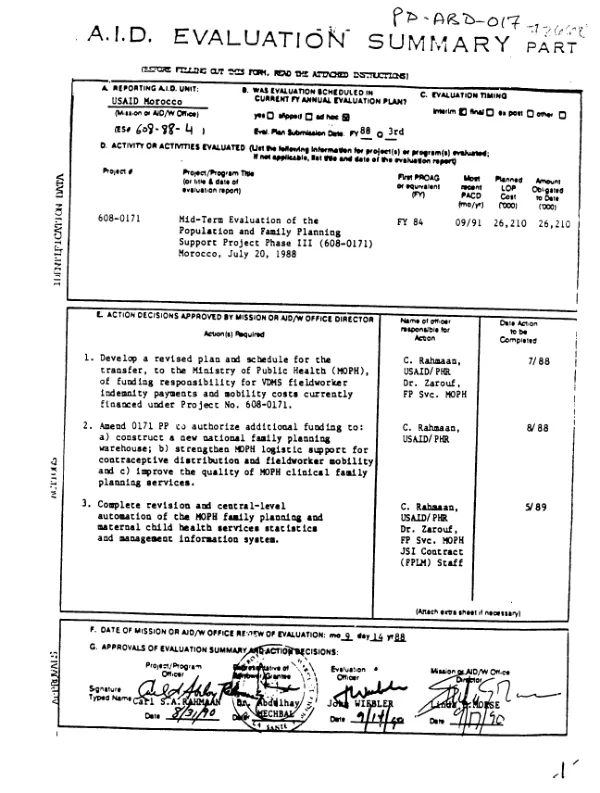
Summarizes mid-term evaluation (PD-AAX-948) of a project to strengthen the ability of Morocco"s Ministry of Public Health (MOPH) to plan and implement family planning (FP) and maternal child health (MCH) programs.
1990
Sign in to readA free account is required to download.
Abstract
The evaluation covered the period FY84-7/88. The project has been successful in increasing the availability and accessibility of FP services and supplies and in increasing contraceptive prevalence. It has also helped influence significant policy and program changes in the population and health sector. A fully operational outreach capacity for FP and other preventive health services is now established in 30 of the country"s 49 provinces. The National Training Center for Reproductive Health has become a model regional training center, and extensive in- service, short-term training conducted under the project has been appropriate. Minimal problems have occurred with logistics management of commodities. Most of the 13 subprojects are on target and 3 of the 4 main objectives have already been reached. These include: (1) an increase in the availability of FP information and services to 70% of the population; (2) an increase of contraceptive prevalence to 35%; and (3) an increased awareness among government planners of the problems of high population growth. Progress has also been made toward the fourth objective, to improve MCH status, although direct indicators are not available. Two subprojects have presented significant problems. Efforts to develop an information, education, and communication strategy have been unsuccessful. Although many mass media messages have been produced, pre-testing is inadequate, quality is uncertain, and the impact is unknown. Printed material for educational use is inappropriate, confusing, out-of-date, and unused. The other subproject, to develop an FP information system, has experienced major problems in system design and implementation, and the current system remains plagued by an over-abundance of unusable data. There are also weaknesses in service delivery, most notably the overreliance on oral contraceptives in meeting contraceptive prevalence targets. Several lessons were learned. (1) As a result of the project"s integrated approach, both workers and clients now view FP as an important MCH intervention. The program is also more widely accepted by government officials, the religious community, and local opinion leaders. (2) Lack of an explicit national population policy has not been a hindrance to the implementation of programs to reduce population growth rates. Emphasis on program implementation rather than policy statements has actually helped to avoid conflicts with more conservative government officials and religious leaders. (3) The project"s campaign- style approach has been useful in mobilizing and sensitizing both providers and the public.
![Assessment of the innovations in family planning services [IFPS] project : summary report](https://covers.devme.ai/gen/35782.webp)