USAID. MISSION TO EGYPT
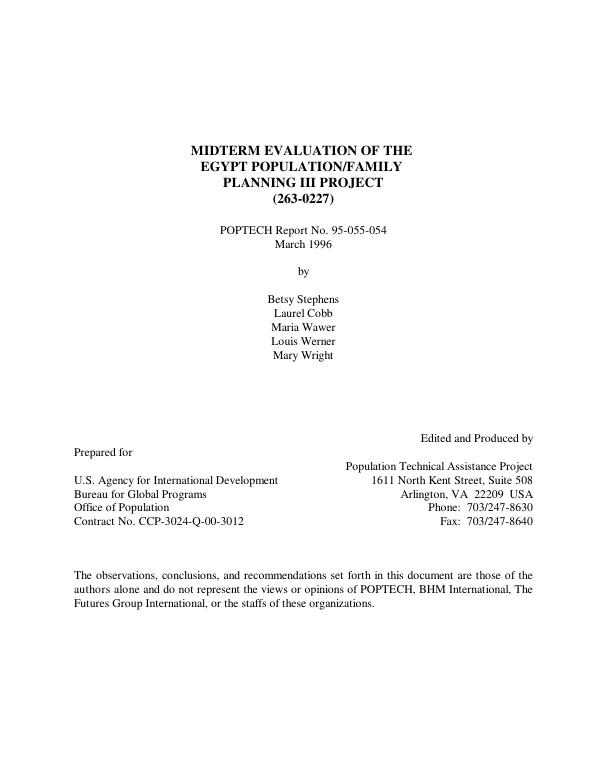
Population/family planning III
Project, follow-on to -0029 and -0144, to increase contraceptive use among married couples in Egypt.
1992
Sign in to readA free account is required to download.
Abstract
The project comprises eight subprojects (SPs), implemented by four Government of Egypt (GOE) agencies and the private sector. The Ministry of Health (MOH) will implement three SPs. (1) The Systems Development SP will introduce a systems approach into the MOH"s family planning (FP) management system through systems analysis, training courses, and workshops. Operational procedures will be refined, and records and data banks will be oriented toward information retrieval by system. This SP will also improve the quality of FP services provided by MOH units and hospitals through training in contraceptive technology and counseling, improved curricula and methodology, strengthening of IEC (information, education, and communication) activities, and a modest amount of clinic renovation and equipping. (2) A Contraceptive Commodity SP will provide IUDs, a limited supply of condoms, and NORPLANT (if approved in Egypt) for distribution to the public sector and to NGO"s that provide FP services. This SP will also further institutionalize MOH contraceptive procurement and management procedures. (3) The Teaching Hospital Organization (THO) SP, initiated under -0144, will continue to provide hospital-based clinical FP services. THO training centers will provide experience in injectable contraceptives, NORPLANT, and surgical contraception, in addition to more common methods. The SP will also develop an outreach program specific to a hospital setting, with maternity, outpatient, and surgical facilities. The National Population Council (NPC) will support two SPs. (1) The Institutional Development SP will continue to develop the capacity of NPC"s Technical Secretariat and governorate-level offices to plan, coordinate, and report on FP activities, as well as the Secretariat"s research management capacities. Each of the 21 governorates will be given a fund for activities to broaden popular support and strengthen staff capabilities. In addition, NPC"s policy outreach will be strengthened in regard to such issues as medical restrictions, private sector constraints, and ministry-level obstacles to cost-recovery. (2) The Regional Center for Training SP of Ains Sham University will continue to provide clinical FP training to physicians (especially private), nurses, and (a reduced number of) trainers. An IEC SP of the Ministry of Information"s State Information Service will continue support for FP mass media messages, as well as interpersonal approaches with local opinion leaders and religious leaders. It will also pay increased attention to coordinating IEC efforts among project implementing agencies. Continued support to the Ministry of Social Affairs (MOSA) will be limited to the Egyptian FP Association"s (EFPA) Clinical Services Improvement (CSI) SP. This SP was initiated under -0144 to develop a sustainable network of EFPA service centers nationwide, introduce quality management systems and procedures, and establish systems to finance the continued operations after donor support ends. A key objective will be to increase cost recovery. As the final SP, the private commercial sector (which provides 70% of all FP services in Egypt) will receive limited support for training, marketing, and TA in key areas such as IEC. Training of private physicians will continue and, in addition, pharmacists will be trained in contraceptive methods and use. Studies to help USAID/E target its FP marketing initiatives will also be funded. Project training will include in-country training for over 22,000 persons and participant training for 60. Amendment (Revised Project Paper) of 11/7/94 introduces six revisions: (1) use of data from the 1992 Demographic and Health Survey for Egypt (EDHS) as baseline for setting targets; (2) restructuring and streamlining of outputs to coincide with the PRISM table submitted to PDS/P on 9/20/94; (3) inclusion of the possible provision of the injectable contraceptive, Depo Provera, as well as NORPLANT; (4) transfer of the CSI SP from MOSA to NPC; (5) inclusion of detailed training information developed during implementation planning; and (6) indication that the next EDHS will be conducted in 1995 rather than 1996. (PD-ABK-131)
Related documents