LINC
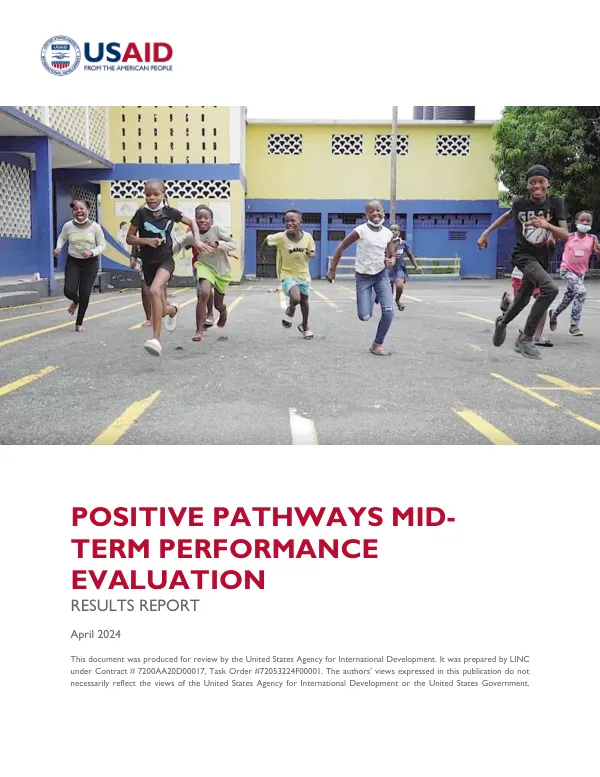
Positive pathways mid-term performance evaluation : results report
The U.S.
Marple-Cantrell, Kate; Conté, Simon +6 more · 2024
Sign in to readA free account is required to download.
Abstract
Agency for International Development commissioned a mid-term performance evaluation of the Positive Pathways activity (2020–2025), which is implemented by Democracy International and aims to prevent community violence by means of a collaborative, problem-solving, positive youth development approach. Between January and March 2024, the evaluation team conducted a document review and 36 key informant interviews with a range of activity stakeholders, including the national government, grantees, civil society organizations, and private sector organizations. In addition, the team conducted 18 focus group discussions and 131 perception surveys with targeted youth participants and parent/family participants. Areas of inquiry included documenting the challenges experienced by Positive Pathways during the first half of activity implementation, assessing the extent to which Positive Pathways improved resilience among targeted youth, and assessing the extent of integration of civil society, government, and private sector partners to address risk and resilience factors. The evaluation found that Positive Pathways faced several challenges—including the COVID-19 pandemic, struggles with leveraging previous program successes, resource and communication limitations, and significant management and staffing changes—and that it adapted in response through in-depth stakeholder consultations and community selection, assistance to partners in converting activities to online delivery, revision of community engagement strategies, and leadership changes. Participating families and youth reported general satisfaction with the Positive Pathways activity, and initial indicators of resilience are promising, but the activity delivery method of short, small grants likely limits the long-term impact of the activity on participants’ lives. The evaluation found general satisfaction among partners with Positive Pathways, noting, in particular, the training and capacity-strengthening efforts that enhanced skills and knowledge for implementing community initiatives. The private sector’s engagement in this space is limited because of various barriers, including misalignment with business objectives, skills and employment gaps, and resource constraints.