JHPIEGO CORP.
Postpartum care survey results from sub-Saharan Africa
The postpartum period is an opportune time to integrate family planning with maternal and newborn health.
Charurat, Elaine; Nash-Mecado, Angela · 2008
Sign in to readA free account is required to download.
Abstract
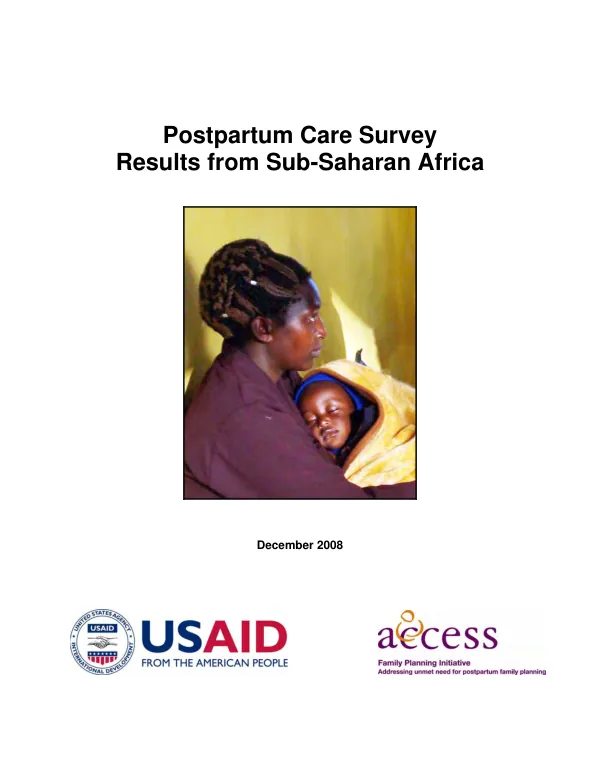
There is, however, a lack of information about postpartum care services offered through projects. In 2008, ACCESS-FP undertook a postpartum care survey, based on a model developed in 2005 by the Extending Service Delivery Project and CATALYST for the Asia and Near East region, to identify, document and share information on the status of postpartum care services implemented by USAID cooperating agencies. This report describes the purpose and scope of the survey, and presents results that will be helpful for program managers, policymakers and health care providers when implementing postpartum care activities. A total of 37 projects in sub-Saharan Africa responded to the survey; most were working in family planning, HIV/AIDS, child survival/child health and maternal and newborn health. Training, service delivery, behavior change communication and community approaches were the main intervention areas of the projects surveyed. Since most of the projects work with women of reproductive age and children under five years, there are opportunities to integrate postpartum family planning (PPFP) with routine immunization, well-child and sick-child visits. Opportunities to include postpartum family planning (PPFP) in trainings also exist in a number of the projects. Survey results indicated that there are a number of opportunities to integrate postpartum family planning (PPFP) with many programs. Recommendations include: (1) utilize community-based volunteers in PPFP interventions; (2) emphasize the Lactational Amenorrhea Method (LAM) as a transition method; and (3) advocate for policies that effectively promote PPFP. (Author abstract, modified)
Related documents
Documents in this collection
 2003
2003USAID DEC
Improving the health of mothers and children of rural Jinotega, Nicaragua : an integrated approach in partnership with the public and private sector providers in coffee-growing areas : KPC baseline survey report
Open record 2006
2006USAID DEC