WINROCK INTERNATIONAL. LIVESTOCK RESEARCH AND TRAINING CENTER
POTENTIAL OF THE WORLD"S FORAGES FOR RUMINANT ANIMAL PRODUCTION
The four papers in this volume concern the world"s forage potential on lands with widely varying growing conditions.
BULA, R. J.; LECHTENBERG, VICTOR L. · 1970
Sign in to readA free account is required to download.
Abstract
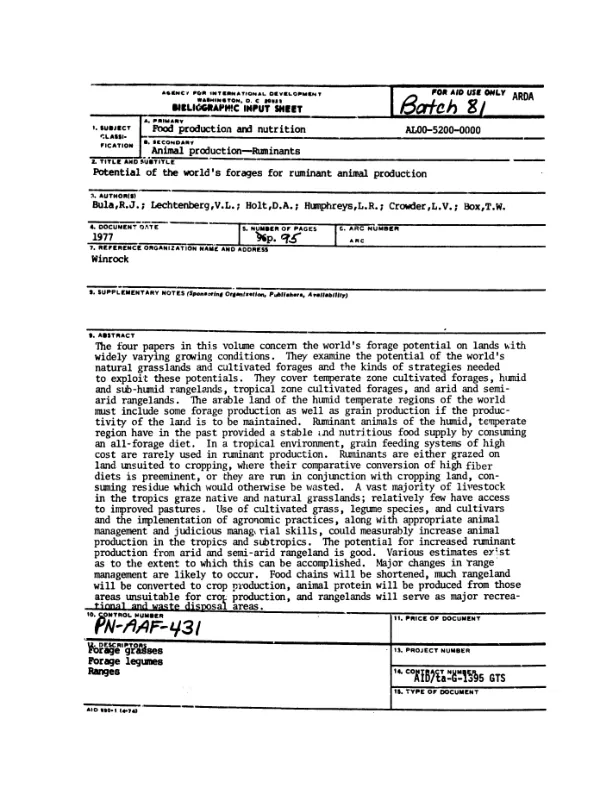
They examine the potential of the world"s natural grasslands and cultivated forages and the kinds of strategies needed to exploit these potentials. They cover temperate zone cultivated forages, humid and sub-humid rangelands, tropical zone cultivated forages, and arid and semi-arid rangelands. The arable land of the humid temperate region have in the past provided a stable and nutritious production as well as grain production if the productivity of the land is to be maintained. Ruminant animals of the humid, temperate region have in the past provided a stable and nutritious food supply by consuming an all-forage diet. In a tropical environment, grain feeding systems of high cost are rarely used in ruminant production. Ruminants are either grazed on land unsuited to cropping, where their comparative conversion of high fiber diets is preeminent, or they are run in conjunction with cropping land, consuming residue which would otherwise be wasted. A vast majority of livestock in the tropics graze native and natural grasslands; relatively few have access to improved pastures. Use of cultivated grass, legume species, and cultivar and the implementation of agronomic practices, along with appropriate animal management and judicious managerial skills, could measurably increase animal production in the tropics and subtropics. The potential for increased ruminant production from arid and semi-arid rangeland is good. Various estimates exist as to the extent to which this can be accomplished. Major changes in range management are likely to occur. Food chains will be shortened, much rangeland will be converted to crop production, animal protein will be produced from those areas unsuitable for crop production, and rangelands will serve as major recreational and waste disposal areas.
Related documents