GREEN POWERED TECHNOLOGY
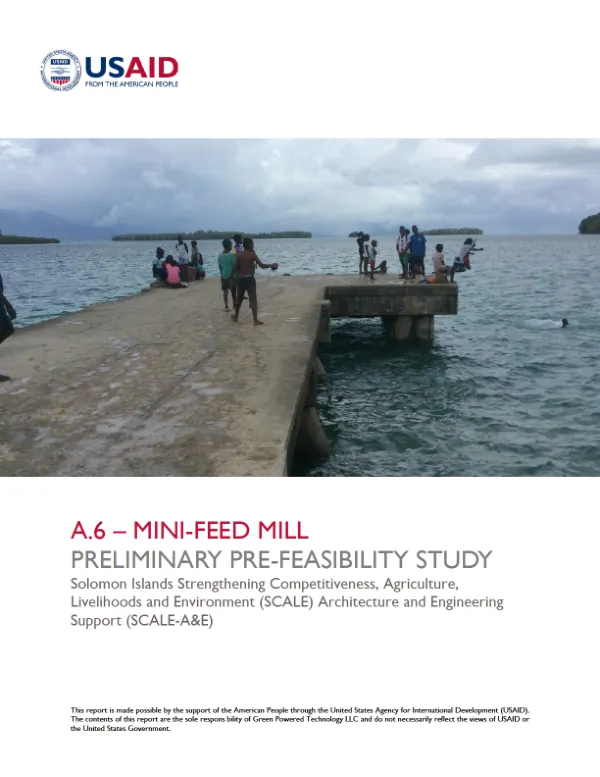
Pre-Feasibility Study – Mini-Feed Mill
The proposed Mini-Feed Mill is a strategic initiative aimed at addressing the lack of local animal feed production in Malaita Province.
2024 · 43 pages
Sign in to readA free account is required to download.
Abstract
The project's objective is to establish a small-scale integrated facility that utilizes local feed ingredients, such as cassava, cassava meal, fish, sweet potato, sorghum, and other products, to produce high-quality feed for livestock. The facility will be designed to be flexible, allowing the chosen operator/manager to process feed based on their preferred raw materials and processes. The proposed location for the Mini-Feed Mill is Gwaigeo, an 8 kilometers north of Auki on the coast of Malaita Province. The site has a total area of 46 hectares, with 12 hectares allocated for the processing and warehousing facilities. The site will require site layout plan, accessibility upgrades, and utility development. The location is strategically located near the North and East roads, with easy access to the largest port on Malaita Province and Gwaigeo Airport. The strategic context of the proposed project is driven by the lack of local animal feed production in Malaita Province, resulting in expensive and time-consuming imports. The Ministry of Agriculture's Livestock Policy supports the development of small-medium scale feed production and formulation, taking into account disaster risk management practices. The proposed facility is expected to have a number of interested operators, including farmers and livestock businesses, and will benefit from the nearby Coconut Processing Mill. The drivers of change for the proposed project are the identified causes and consequences of a market failure, which require strategic interventions to realize desired benefits. The project will assess the strategic context, identify key drivers, and develop a comprehensive plan to address the market failure. The proposed Mini-Feed Mill will utilize local feed ingredients, including cassava, cassava meal, fish, sweet potato, sorghum, and other products, to produce high-quality feed for livestock. The facility will be designed to be flexible, allowing the chosen operator/manager to process feed based on their preferred raw materials and processes. The proposed location for the Mini-Feed Mill is Gwaigeo, an 8 kilometers north of Auki on the coast of Malaita Province. The site has a total area of 46 hectares, with 12 hectares allocated for the processing and warehousing facilities. The site will require site layout plan, accessibility upgrades, and utility development. The strategic context of the proposed project is driven by the lack of local animal feed production in Malaita Province, resulting in expensive and time-consuming imports. The Ministry of Agriculture's Livestock Policy supports the development of small-medium scale feed production and formulation, taking into account disaster risk management practices. The proposed Mini-Feed Mill will have a number of benefits, including: * Addressing the lack of local animal feed production in Malaita Province * Utilizing local feed ingredients, reducing imports and reducing the environmental impact * Providing high-quality feed for livestock, improving livestock health and productivity * Creating employment opportunities for local communities * Supporting the development of small-medium scale feed production and formulation * Addressing disaster risk management practices The proposed Mini-Feed Mill will have a number of risks, including: * Market risks, such as changes in demand or supply * Operational risks, such as equipment failure or equipment failure * Financial risks, such as changes in funding or revenue * Environmental risks, such as pollution or environmental degradation The proposed Mini-Feed Mill will have a number of stakeholders, including: * Farmers and livestock businesses * Livestock producers * Local communities * Government agencies * Private sector companies * Providing high
Related documents
Documents in this collection
 2021
2021USAID DEC
Food, Energy, Water Baseline Assessment for Solomon Islands Strengthening Competitiveness, Agriculture, Livelihoods and Environment (SCALE) Architecture and Engineering Support
Open record 2021
2021USAID DEC