USAID. MISSION TO HONDURAS
Primary education efficiency project
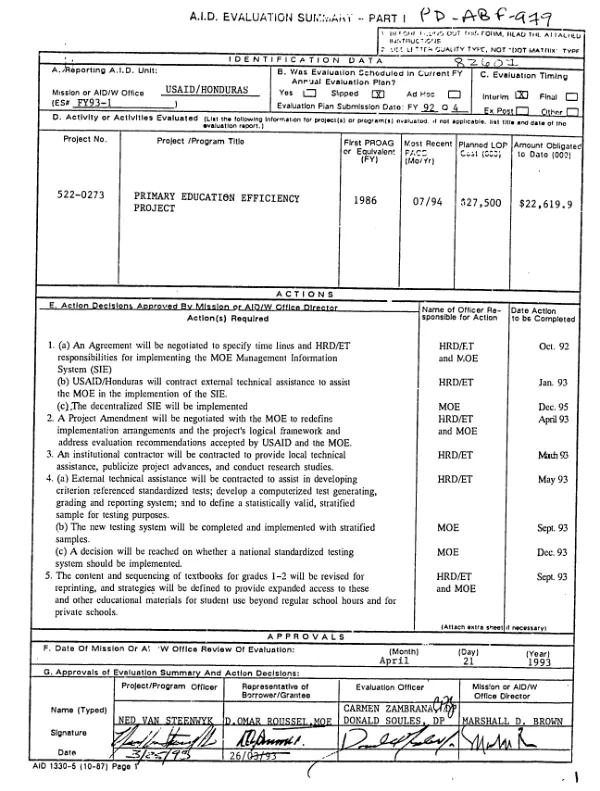
Summarizes a midterm evaluation of a project to improve the quality, efficiency, and cost-effectiveness of Honduras" primary education system.
1993
Sign in to readA free account is required to download.
Abstract
Evaluation covers the period 1986-8/91. Major findings and conclusions were as follows. (1) Overall, project performance at midpoint is satisfactory. Its most significant impact will be on the quality of education, through the textbook and training components. These two components will meet their output targets by the end of the project. Funding and production should continue as planned. (2) Major problems exist in the availability and reliability of data to track the impact of the project. Several studies should be conducted in the next year by external consultants in order to provide a base of information for the final evaluation. (The Mission did not fully agree with this finding or recommendation, pointing out that the project is using internationally recognized measures of efficiency and quality to track its impact). (3) Assumptions in the design of the project that textbooks and training would significantly improve efficiency and cost effectiveness are faulty. Success in these activities will not necessarily affect these indicators. Emphasis should be moved from efficiency to quality. (The Mission directly disputed this finding, and dismissed the recommendation as inappropriate). (4) Each component was treated as a separate activity. No provision was made for overall coordination of the components. Efforts should be made to better integrate the activities of the textbook, training, and evaluation components. (Once again, the Mission did not agree with this finding, pointing out that provisions had been made, but that extenuating circumstances had negative impacts on coordination and implementation.) Major lessons learned include the following. (1) Project monitoring provides the crucial link between stages of project design, implementation, and evaluation. Each stage is generally the responsibility of a different institution (MOE, USAID, and contractors). Unless clear responsibility is delegated for monitoring, feedback linkages easily dissolve. (2) Accurate assessment of host country capabilities is essential for successful implementation and institutionalization of project activities. Human, physical, and financial resources all must be assessed. (3) Establishing baseline measures is essential if project impact is to be tracked. (Author abstract, modified)
Related documents