USAID DEC
Primary education for all : learning from the BRAC (Bangladesh Rural Advancement Committee) experience : a case study
Sign inACADEMY FOR EDUCATIONAL DEVELOPMENT, INC. (AED)
Primary education for all : learning from the BRAC (Bangladesh Rural Advancement Committee) experience : a case study
A case study is presented of the Bangladesh Rural Advancement Committee"s (BRAC) highly successful Nonformal Primary Education (NFPE) program, which provides basic education to thousands of rural Bangladeshi children -- especially girls -- not being reached by the formal primary education system.
Ahmed, Manzoor; Chabbott, Colette · 1970
Sign in to readA free account is required to download.
Abstract
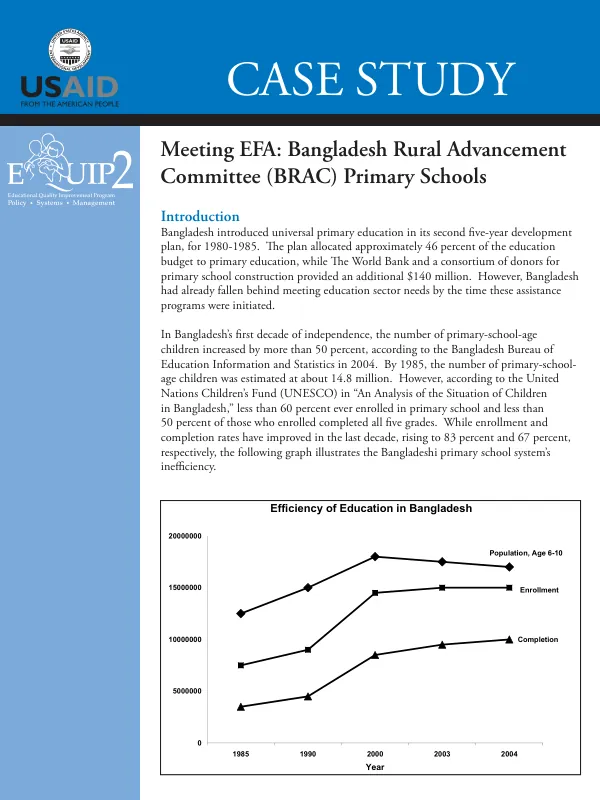
The NFPE program, which began in 1985 in 22 villages, has already expanded to more than 8,000 schools, serving children aged 8-16. After an introductory overview, the study examines the strengths and weaknesses of the NFPE program, covering the program"s history, detailed descriptions of its individual elements, BRAC"s approach to NFPE management, and the cost-effectiveness of BRAC schools. Key sources of NFPE"s success are identified as the use of a low-cost, rapidly replicable model capable of reaching the most disadvantaged children, BRAC"s use of surveys to target programs towards the most disadvantaged rural families, and its encouragement of family and community involvement. The next section discusses the potential for rapidly expanding the NFPE program to 15,000 schools, and in particular the possible relationship between a large-scale NFPE program and the national system of primary education. According to the report, while expansion of the program is likely to increase program costs, only extremely large increases could make the program cost-ineffective. A final section analyzes the elements of the NFPE program that might be relevant to efforts at expanding educational systems in other countries, though stopping short of offering definite conclusions in this regard.
![Primary education for all : learning from the BRAC [Bangladesh Rural Advancement Committee] experience -- executive summary](https://covers.devme.ai/gen/54008.webp)