USAID. MISSION TO BURMA
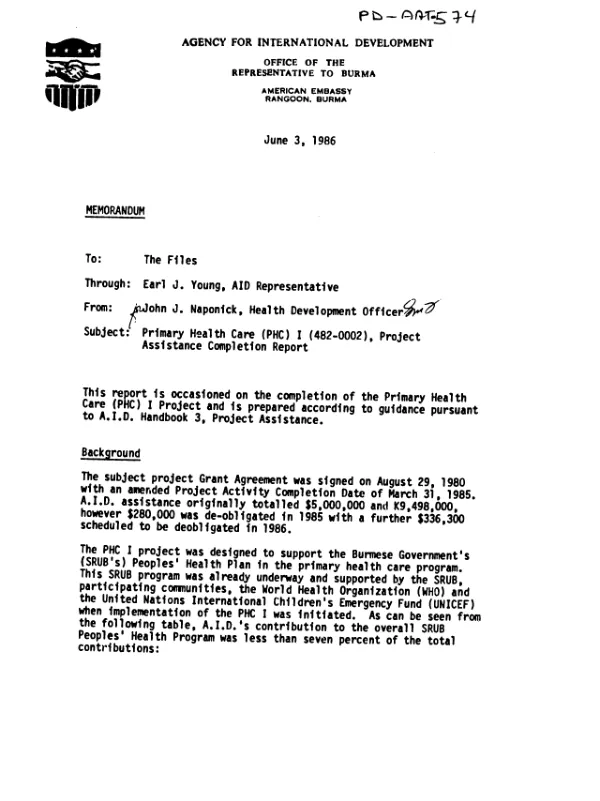
Primary health care (PHC) I (482-0002) : project assistance completion report
Presents final Mission report (8/80-3/85) on A.I.D.'s part in a multi-donor effort to reduce maternal and infant/child morbidity and mortality by expanding the Government of Burma's primary health care (PHC) program.
Naponick, John J. · 1986
Sign in to readA free account is required to download.
Abstract
The project (which provided less than 7% of total program contributions) was successful in: procuring commodities (medical supplies, hospital equipment, training and health information materials), although the commodities arrived later than expected; providing appropriate TA; providing pre- and in-service training of volunteer health workers (community health workers, auxiliary midwives, traditional birth attendants); training 10 participants (all returned to Burma); and providing health worker coverage of the 147 target townships (although coverage by auxiliary midwives was only 75% of target). Although seven studies were completed, data were often suspect and analyses incomplete. Thus, while the project did expand the PHC program, it cannot be shown that it helped reduce maternal and infant/child morbidity and mortality. In a second key area, supervision, especially of mid-level health workers, proved, due to its infrequency and inadequacy, to be the weakest link in the project. While a follow-on project will address this problem by providing supervision training, it is imperative that decentralized monitoring, information, and evaluation systems be developed. Also, increased emphasis should be put on the preventive aspects of health care.
Connected topics
Related documents
![International Medical Corps : Angola relief and rehabilitation -- structural redevelopment of health services in rural Angola : grant no. AOT-0003-G-00-2077[-00] -- final report](https://covers.devme.ai/gen/7328.webp)